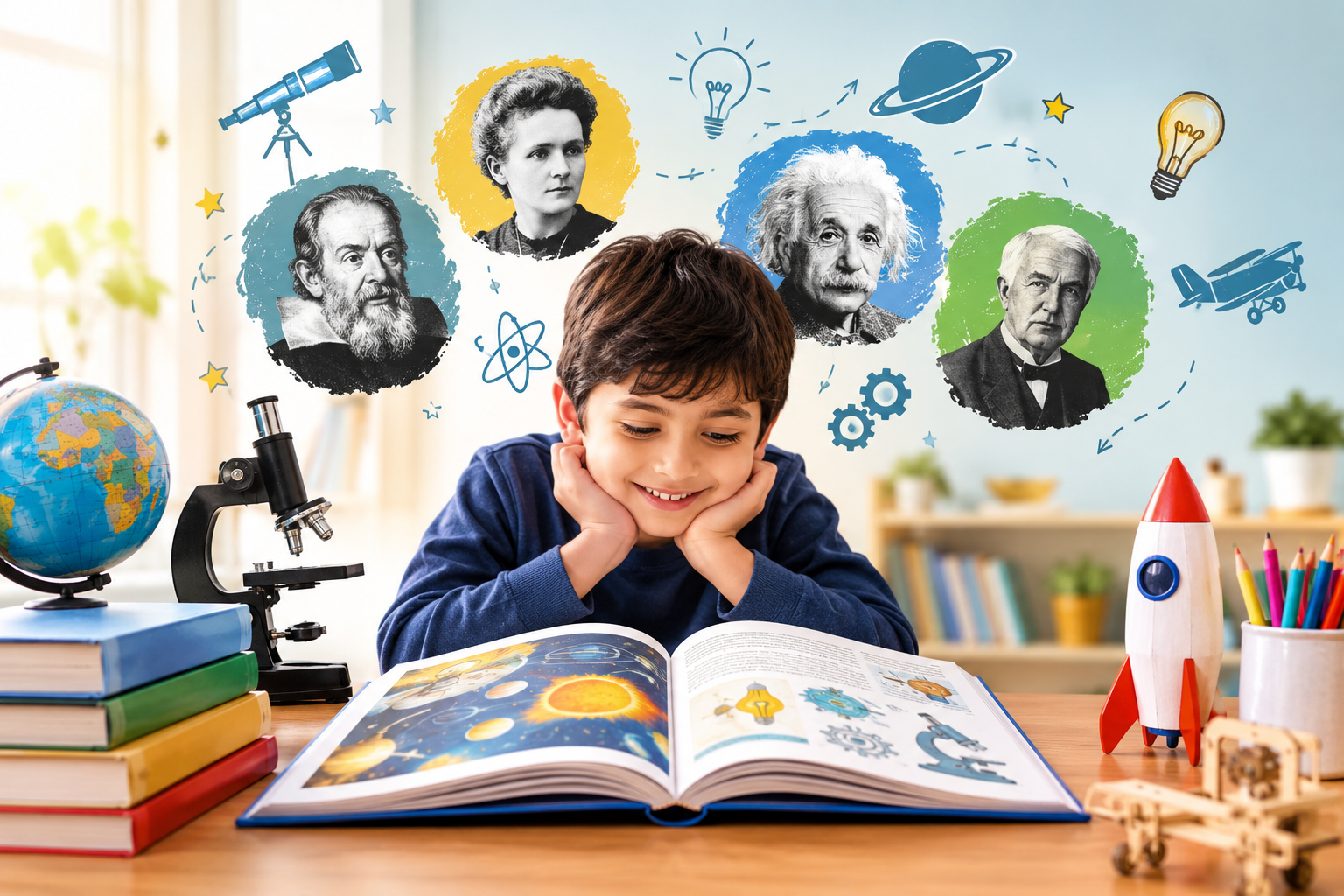
A children's science reference that connects famous people, big questions, and the discoveries that changed everyday life.
Children's Encyclopedia: Scientists, Inventions and Discoveries is a 128-page paperback from V&S Publishers that introduces readers aged 8 to 13 to famous scientists and to the breakthroughs that changed everyday life. It tells the short life stories of people such as Archimedes, Galileo, Newton, Darwin, Pasteur, Faraday, Marie Curie, Einstein and Thomas Alva Edison, and then explains major inventions like vaccines, electricity, the aeroplane and the steam engine. This article explains what the book covers, why scientist stories make children curious, and how families and teachers can use it well.
Quick Answer
What is it? A children's science reference book in two parts: Part I covers the lives and contributions of well-known scientists, and Part II covers major inventions and breakthroughs.
Who is it for? Children aged 8 to 13, school students who want a supplementary reader, and parents or teachers building a home or classroom science shelf.
What does it cost? Rs. 250 (about USD 12). It is a paperback with black and white pages, written in English.
Where does it sit? It is one of five books in the series Children's Encyclopedia: The World of Knowledge, published by V&S Publishers.
Book Details at a Glance
| Book Detail | Information |
|---|---|
| Book name | Children's Encyclopedia: Scientists, Inventions and Discoveries |
| Subtitle | Familiarises children with important Inventions and Discoveries |
| Publisher | V&S Publishers, a Delhi-based house with a history that began in the 1940s |
| Age group | 8 to 13 years |
| Language | English |
| Binding | Paperback |
| Pages | 128, printed in black and white |
| Price | Rs. 250 (USD 12) |
| Category on our site | Children's Books and Reference Books |
Why a Scientist's Story Can Do What a Formula Cannot
A child who reads that water pushes up on objects placed in it learns a fact. A child who reads about the person who first worked out why some things float learns that a real human being once wondered about the same thing. The second experience is the one that tends to stay in memory, because a story gives the idea a face, a place and a problem to solve.
That is the thinking behind this encyclopedia. Textbooks present the finished law. A biography shows the questions that came before it, the wrong turns, and the patience that eventually paid off. When children see that every great discovery began with someone asking “why”, they begin to see themselves as people who are allowed to ask the same question.
Curiosity also grows when a child can connect ideas across subjects. A story about a doctor and a vaccine touches biology, history and public health at once. A story about a telescope touches physics, astronomy and the way new tools change what people can see. A well-organised children's encyclopedia gives young readers many such doorways in one affordable volume.
What You Will Find Inside the Book
The book is divided into two parts, which makes it easy for a child to choose where to begin.
Part I: Scientists. This part presents brief life histories and the main contributions of well-known scientists. The names listed for the book include Archimedes, Albert Einstein, Charles Darwin, Galileo, Newton, Louis Pasteur, Michael Faraday, Marie Curie and Thomas Alva Edison, along with many more.
Part II: Inventions and Breakthroughs. This part looks at major advances that changed human life, including bacteria, vitamins, vaccines, the aeroplane, electricity, cinema and the steam engine.
Because the first part is about people and the second is about ideas, the book works as both a storybook and a quick reference. A child can read one biography at bedtime, or a student can look up a topic before a school quiz. If your reader is older, around 11 and above, our companion title 71 Famous Scientists offers longer biographies of 71 scientists and inventors.
Five Lives That Show How Curiosity Really Works
The book's scientists come from different centuries and countries, yet their stories share a pattern. Here are five examples, with facts checked against reputable institutions, that show why these lives are so useful for young readers.
Charles Darwin: Curiosity Needs a Long Journey
After graduating in 1831, Darwin joined HMS Beagle as an unpaid naturalist. The voyage lasted until 1836, and during it he collected fossils and specimens and studied geology around South America and the Galapagos Islands, according to the Smithsonian Institution. His book On the Origin of Species followed in 1859. The lesson for a child is simple: careful, patient observation can lead to an idea that reshapes biology.
Galileo: Great Discoveries Often Come From Improving a Tool
Many children are told that Galileo invented the telescope, but that is not accurate. According to Space.com's anniversary account, he did not invent it. What he did was build better ones and use them to study the Moon, stars and planets. By January 1610 he had made a stronger telescope and found four moons of Jupiter, and he published his findings in Sidereus Nuncius in March 1610. Children can see that science is as much about asking what a tool can reveal as about building the tool.
Louis Pasteur: Courage and Care Together
In July 1885, a nine-year-old boy named Joseph Meister, bitten fourteen times by a rabid dog, was brought to Pasteur's laboratory. The Institut Pasteur records that Dr Jacques Joseph Grancher gave the boy twelve doses of the vaccine and that the child survived. The Institut Pasteur itself was created in 1887 after this success. It is a gripping story that introduces young readers to vaccines and to the idea that testing, teamwork and bold decisions all matter in medicine.
Michael Faraday: Talent Does Not Need a Perfect Start
Faraday began as a bookbinder's apprentice and read widely in the shop. In 1812 he attended lectures by the chemist Humphry Davy at the Royal Institution, and in 1813 he was hired there as a chemical assistant, according to the Royal Society of Biology. In 1831 he demonstrated electromagnetic induction, the principle behind generators and transformers. He also became a gifted teacher of young people. The Royal Institution notes that he helped turn its Christmas Lectures into a major event for young audiences.
Marie Curie: Persistence Across Fields
The official Nobel Prize biography explains that Marie Curie was born in Warsaw, moved to Paris to study, and shared the 1903 Nobel Prize in Physics with Pierre Curie and Henri Becquerel. She later won the 1911 Nobel Prize in Chemistry on her own, becoming the first person to win two Nobel Prizes. During the First World War she organised mobile X-ray teams. Her story shows children that serious work can cross the boundaries between subjects.
Inventions That Changed Ordinary Days
Part II of the book moves from people to breakthroughs, and each one has a story that children can explain to their friends.
- Vaccines. The World Health Organization notes that Edward Jenner created the first successful vaccine in 1796, after noticing that milkmaids who had caught cowpox did not catch smallpox. The same WHO page on smallpox records that WHO declared smallpox eradicated in 1980. This connects directly to the Pasteur story above and gives a child a clear timeline: 1796, 1885, 1980.
- The aeroplane. On 17 December 1903, Orville Wright made the first powered, controlled and sustained flight at Kitty Hawk, North Carolina. It lasted 12 seconds and covered 120 feet, as described by HistoryNet. Children enjoy comparing that tiny hop with a modern airport runway.
- Electricity. Faraday's work on induction, mentioned above, helps explain how electric power is generated. A child who has read his biography already holds the first half of the story.
- Bacteria, vitamins, cinema and the steam engine. These topics complete the second part, and each one shows how a single idea can change health, entertainment or transport for millions of people.
For children who like to build and test ideas, our blog on 101+10 New Science Games describes a hands-on activity guide with 111 experiments and working models for ages 8 to 15, which makes a natural next step after reading about inventions.
Four Common Myths, Corrected
Fact: He improved the instrument and used it in groundbreaking ways, but the telescope was not his invention, as the Space.com account noted earlier explains. His real achievement was what he observed and published.
Fact: The Nobel Prize record for Albert Einstein states that the 1921 Physics prize was awarded for his services to theoretical physics, especially his discovery of the law of the photoelectric effect. The prize for 1921 was reserved and presented to him in 1922. The same page also notes that he worked at the patent office in Bern during the years when he produced several pioneering works.
Fact: Faraday received only a basic formal education and still became one of history's great experimentalists. His example does not mean schooling is unimportant. It means curiosity and hard work can open doors that circumstances seem to close.
Fact: The Nobel biography of Marie Curie says she produced radium as a pure metal in 1910, years after the Curies first discovered the new elements. Real science is usually a long road with many small steps.
A Four Week Reading Plan for Home or Classroom
A book becomes much more powerful when it is used actively. This plan is built from the scientists and topics named in the book's description. It asks for about three short reading sessions a week and one simple activity, so it fits comfortably around school.
Read about Archimedes, Galileo and Newton. For an activity, fill a basin with water and let your child predict which household objects will float and which will sink, then check. On a clear evening, you can also look at Jupiter with binoculars. A NASA JPL post on Galileo's first sightings describes how his four Jupiter moons can be spotted with a simple pair.
Read about Darwin and Pasteur, then the Part II topics on bacteria and vaccines. Ask your child to keep a small nature notebook and draw two leaves or birds, noting how they differ. Then build a three-date vaccine timeline: 1796, 1885 and 1980.
Read about Faraday and Edison, then the topics on electricity, the steam engine and cinema. Edison is famous for work on the phonograph and electric lighting, so your child can compare how each invention changed the home. For a supervised circuit activity, see our blog on 71 Electrical and Electronic Projects, a project-based STEM book on circuits and working models.
Read about Marie Curie and Einstein, then the topics on the aeroplane and vitamins. Let your child fold paper planes and measure their flights, then compare the distances to the 120 feet of the first powered flight. Finish the month by asking: “Which scientist faced the hardest problem, and what helped them keep going?” Our article on how to develop a winning mindset with lessons from history offers more on resilience and learning from setbacks.
Good reading habits matter as much as good books. A short, regular session, with a place to talk about what was read, tends to work better than long cramming sessions. For families who want to understand how memory and focus develop, our guide on what brain power is and how to improve it is a helpful companion.
Who Will Enjoy This Book, and Who May Need Something Else
It Suits
Curious children aged 8 to 13, students who like quizzes and general knowledge, families building a home library, and teachers who want a supplementary reader for science lessons. Because the book is organised by scientist and by invention, even a reluctant reader can pick one short entry and finish it in a sitting.
It Is a Reference, Not a Lab Manual
The book is a knowledge book, so children who want to experiment will enjoy it more when paired with an activity book. Our blog on the Hindi title 71+10 New Science Projects describes 81 projects across physics, chemistry, biology and electronics for ages 8 to 15, for families who prefer Hindi.
It Is Printed in Black and White
At Rs. 250 for 128 pages, the book keeps the price accessible for families and schools. Parents who prefer colour pictures should look at the sample pages or description before buying and decide what suits their child.
Older Readers May Want More Depth
Students above 11 who want longer biographies can move on to 71 Famous Scientists, mentioned earlier. For exam-focused readers, a study skills guide such as 251 Study Secrets covers confidence, memory, concentration and exam preparation habits.
Where This Book Fits in the V&S Catalogue
V&S Publishers has published educational books since the 1940s, and its catalogue now includes more than 2,000 titles across Olympiad guides, children's books, reference books and self-help. You can read more about the company on the About V&S Publishers page.
This encyclopedia belongs to the Reference Books section of our book categories, alongside dictionaries and atlases. It is part of the Children's Encyclopedia: The World of Knowledge series, whose family also includes titles such as Life Sciences and General Knowledge.
Students who enjoy the science stories may also like our Olympiad books for Maths, Science, English, Cyber and General Knowledge, written for Classes 1 to 12. Schools, libraries and bookshops can learn about bulk supply on our distribution page, and parents can browse the V&S Publishers children's store on Amazon to buy. For more reading ideas, visit the V&S blog.
Questions Parents and Teachers Ask
What is Children's Encyclopedia: Scientists, Inventions and Discoveries about?
It is a children's science book from V&S Publishers in two parts. Part I presents short life histories of famous scientists such as Archimedes, Einstein, Darwin, Galileo, Newton, Pasteur, Faraday, Marie Curie and Edison. Part II explains major inventions and breakthroughs such as vaccines, electricity, the aeroplane and the steam engine.
What age group is the book written for?
It is written for children aged 8 to 13. Younger readers may enjoy it with a parent, and older students can use it as a quick reference.
How many pages does it have, and what is the price?
It has 128 pages in paperback with black and white printing. The MRP is Rs. 250, or about USD 12.
Is it part of a series?
Yes. It is one of five books in the series Children's Encyclopedia: The World of Knowledge from V&S Publishers.
Can school students use it as a reference book?
Yes. The publisher's description says school students can use the book as a reference or guide, and its two-part layout makes it simple to look up a scientist or an invention.
Is the book useful for general knowledge and quiz preparation?
It is useful for “who discovered what” questions and for building background knowledge. For formal competition practice, pair it with dedicated Olympiad preparation books.
Which language is the book published in?
It is published in English.
How can parents get the most from it?
Read one short entry at a time, ask your child what they would have done in the scientist's place, and follow each story with a small activity. The four-week plan in this article shows one way to do it.
A Final Thought
Children do not need to become scientists to benefit from scientist stories. They need to see that questions are welcome, that mistakes are part of the process, and that people from very different backgrounds have helped the world understand itself better. A well-chosen children's encyclopedia opens that door at a price families can afford.
If you want a first science book that connects people to ideas, Children's Encyclopedia: Scientists, Inventions and Discoveries is a practical place to begin. Browse the full range on our categories page and let your child's curiosity choose what to read next.