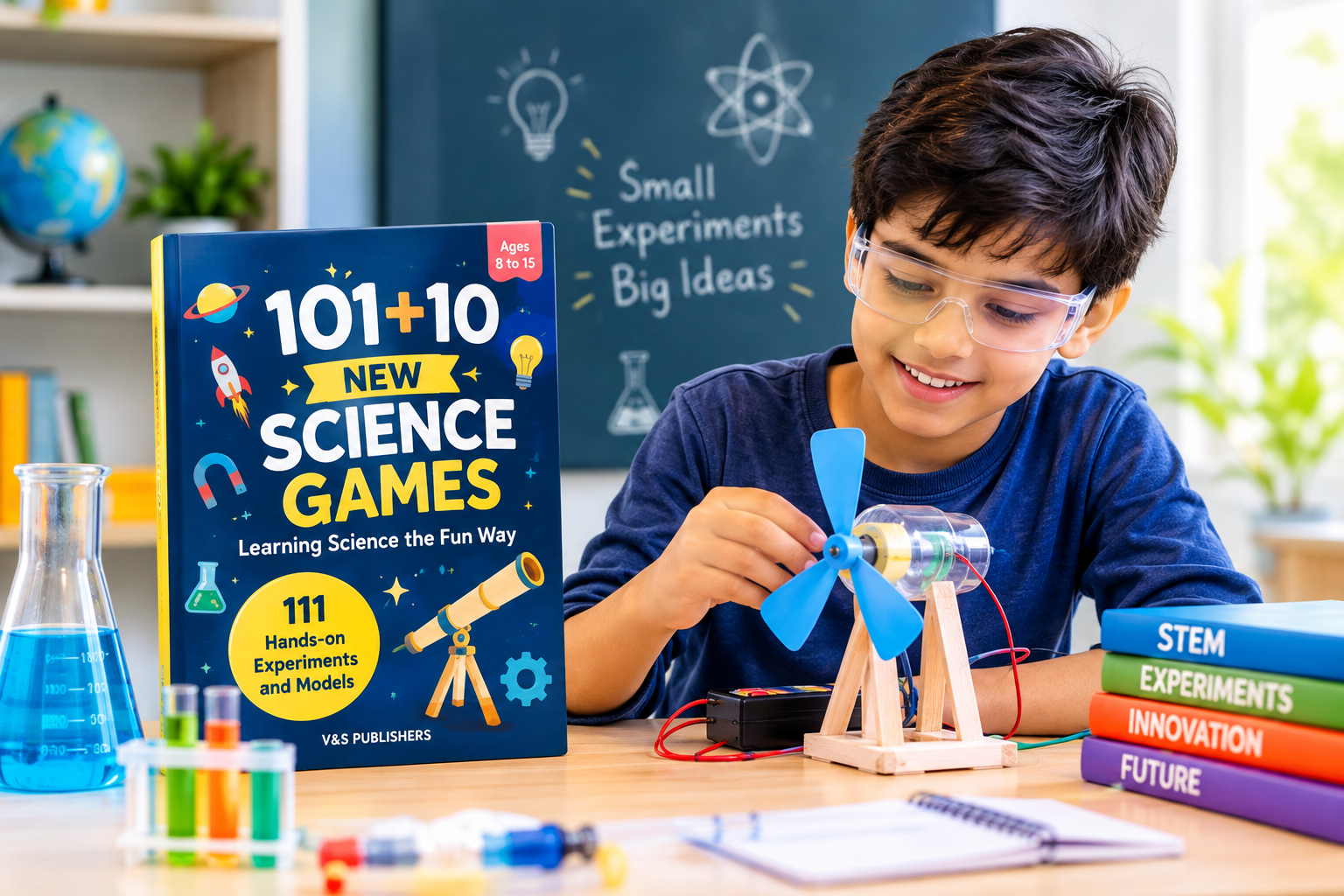
Every parent has heard the question at some point: “Why do I need to learn this?” Science, more than almost any other school subject, answers that question best when a child can touch it, build it, and watch it work. That is exactly the gap that 101+10 New Science Games, published by V&S Publishers , is built to fill.
This is not a textbook. It is a science activity book for kids that turns 111 scientific principles into hands-on projects, ranging from a working telescope to a homemade steam turbine. In this guide, we will unpack what is inside the book, why hands-on science learning activities matter for children between 8 and 15 years, and how this title compares to other STEM project ideas for students available today.
Why Science Activity Books Matter More Than Ever in 2026
Children today are growing up surrounded by screens rather than science kits. Recent data tracking Indian children’s screen habits found that adolescents now average close to four to five hours a day on screens, a figure that has risen sharply since the pandemic. A separate peer-reviewed study on secondary school students in rural India reported that excess screen time affected 83.2 percent of that group, with mobile phones being the most used device.
That shift matters because passive screen time and active, hands-on learning produce very different outcomes. According to education research summarised by Accelerate Learning , hands-on learning stands out as one of the most effective learning strategies for complex subjects in STEM. It lets students develop the tools, skills, and experiences that create passion in lifelong learners.
In a large-scale study of students entering STEM fields, 92.6 percent of participants identified hands-on lab work as the key factor that inspired them to pursue STEM degrees and careers. The economic case is just as strong. U.S. Bureau of Labor Statistics data shows that employment in STEM occupations is expected to grow by 10.4 percent from 2023 to 2033, compared to just 3.6 percent for non-STEM occupations.
Quick Data Snapshot
| Statistic | Figure | Source |
|---|---|---|
| Students citing hands-on lab work as key to choosing STEM careers | 92.6% | eSchool News / Vernier research review |
| Projected STEM job growth, 2023 to 2033 (US) | 10.4% | U.S. Bureau of Labor Statistics |
| Projected non-STEM job growth, 2023 to 2033 (US) | 3.6% | U.S. Bureau of Labor Statistics |
| Excess screen time among rural Indian secondary students | 83.2% | Peer-reviewed study, rural India |
| Children reached through mobile hands-on science lab programmes | 1.2 million+ | Peer-reviewed public health research |
| 101+10 New Science Games total activities | 111 | V&S Publishers |
| Recommended age group | 8 to 15 years | V&S Publishers |
Inside 101+10 New Science Games: What Makes This Book Different
The full title of the book carries its own promise: Learning Science the Fun Way. Instead of long chapters of theory, the book is structured as a project-based learning resource where every concept is paired with an activity the child actually performs.
Book Snapshot
| Book Detail | Information |
|---|---|
| Book Title | 101+10 New Science Games |
| Subtitle | Learning Science the Fun Way |
| Publisher | V&S Publishers |
| Category | Children’s Books, Popular Science |
| Age Group | 8 to 15 years |
| Language | English |
| Binding | Paperback |
| Colour | Black and White |
| Pages | 130 |
| Price | Rs. 200 (approx. USD 12) |
| Extras | Supplementary online content available through Dropbox |
The book shows readers how science experiments can be interesting and useful for discovering the mysteries of nature. Each project comes with fully illustrated, step-by-step instructions, which is crucial for a science activity book designed for children rather than trained lab technicians.
Readers can browse similar titles on the children’s books collection page .
What Kids Will Build: Seven Signature Science Projects Explained
Among the 111 activities, seven flagship projects give a clear sense of the book’s range across physics, optics, and basic engineering. These are excellent examples of DIY experiments and working models that can also be used for school science fairs.
Telescope
Building a simple telescope introduces children to lenses, focal length, and how light bends to magnify distant objects. The result is immediately visible and rewarding.
Barometer
A homemade barometer teaches air pressure and basic meteorology. Children learn to read pressure changes and connect them to weather patterns.
Hectometer
Making a working hectometer-style measuring tool introduces distance measurement and unit conversion through a practical activity.
Model Electric Motor
The model electric motor demonstrates electromagnetism and explains how electrical energy converts into motion.
Electroscope
An electroscope demonstrates static electricity and charge detection using simple household materials.
Periscope
The periscope project teaches reflection and the behaviour of light using mirrors while creating a fun working model.
Steam Turbine
A homemade steam turbine introduces thermodynamics and energy conversion while connecting learning with the history of steam power.
The Science Behind Hands-On Learning, Backed by Research
Early childhood education research notes that STEM encourages a love of learning and promotes analytical skills. Children have an innate curiosity that hands-on, exploratory activities are well suited to develop.
A peer-reviewed public health study on mobile science laboratory programmes found that such initiatives had reached over 1.2 million children across the United States and internationally.
There is also a confidence dimension. Many children experience science or maths anxiety, but the National Inventors Hall of Fame notes that high-quality STEM learning can help children become more confident in these subjects.
How This Book Supports School Science Fairs and Project-Based Learning
101+10 New Science Games is designed around household materials and clear instructions, making it genuinely useful for:
- School science fair projects completed within one or two weeks
- Weekend STEM activities outside routine homework
- Holiday learning projects that do not require a school laboratory
- Homeschool and supplementary science curricula
Supplementary digital material available through Dropbox extends the printed activity book without requiring a dedicated app or paid subscription.
Age-Appropriate STEM: Why 8 to 15 Years Is the Sweet Spot
By age eight, most children have the fine motor skills and reading comprehension required to follow multi-step instructions independently, while still retaining the natural curiosity that fuels experimentation.
By age 15, students are old enough to understand the underlying physics of a steam turbine or the electromagnetism of a model motor rather than simply following the construction steps mechanically.
The book can therefore grow with the child. A younger reader might begin with the electroscope or periscope, while an older student tackles the model electric motor or steam turbine.
Comparing 101+10 New Science Games With Other Popular Activity Books
Parents searching for the best STEM book for school students are usually comparing several similar titles, many of which can be found on the full book categories page .
| Feature | 101+10 New Science Games | Typical Activity Book |
|---|---|---|
| Number of activities | 111 | 30 to 50 |
| Age range | 8 to 15 years | Often 6 to 10 years |
| Format | Fully illustrated, step-by-step | Often text-heavy |
| Bonus content | Online content through Dropbox | Rarely included |
| Focus | Working models and science principles | Often trivia or one-off tricks |
| Price point | Rs. 200 (approx. USD 12) | Comparable or higher |
| Publisher legacy | V&S Publishers, since 1940 | Varies widely |
How to Use This Book at Home: A Simple Step-by-Step Plan
- Read the description together first. Discuss the scientific principle demonstrated by the project.
- Gather household materials in advance. Most activities use affordable items already available at home.
- Start with a simple project. The electroscope or periscope are good entry points.
- Move to model building. Attempt the electric motor, barometer, or hectometer as confidence grows.
- Use the steam turbine as a milestone project. Try it after completing several easier activities.
- Document the results. Encourage the child to record observations using the scientific method.
A Simple Buying Guide: Who Should Get This Book?
Parents of curious 8 to 11-year-olds will find this a natural extension of school science lessons.
Parents of 12 to 15-year-olds preparing for science exhibitions can use the model electric motor and steam turbine projects.
Teachers and school librarians will appreciate that most projects use materials available at home or in a basic school supply cupboard.
Homeschooling families can use the project-based structure as a practical supplement to a formal science curriculum.
Gift buyers receive 111 educational activities at an accessible price. Families preparing children for competitive exams may also explore V&S Publishers’ Olympiad preparation guides .
About V&S Publishers: A Legacy of Educational Publishing Since 1940
101+10 New Science Games is published by V&S Publishers , a Delhi-based educational publishing house active since the 1940s. Its catalogue contains more than 2,000 titles across over 100 subjects and nine languages.
The publishing house has received recognition at industry events, including a Federation of Indian Publishers award for excellence in book production.
Frequently Asked Questions
What age group is the book suitable for?
The book is designed for children aged 8 to 15 years.
How many activities are included?
The book contains 111 activities covering physics, basic electronics, optics, engineering, and measurement.
Does the book require expensive laboratory equipment?
No. The projects use household items and simple materials.
Is there any digital or online content?
Yes. Supplementary online content is available through Dropbox.
Is the book suitable for school science fairs?
Yes. Projects such as the electric motor, periscope, telescope, and steam turbine are visual and easy to explain.
Who publishes 101+10 New Science Games?
The book is published by V&S Publishers.
Can the book be used for homeschooling?
Yes. Its step-by-step activities work well alongside a formal science curriculum.
What subjects does the book cover?
It covers physics, optics, measurement, mathematics, basic electronics, meteorology, and engineering principles.
Final Thoughts
Between rising screen time and a job market shifting toward STEM roles, hands-on science activity books have become increasingly valuable. 101+10 New Science Games gives children a structured way to build practical models while understanding the science behind them.
For parents and educators looking to buy science project books online, this title offers a wide activity count, a broad age range, and the backing of a publisher with more than eight decades of experience.