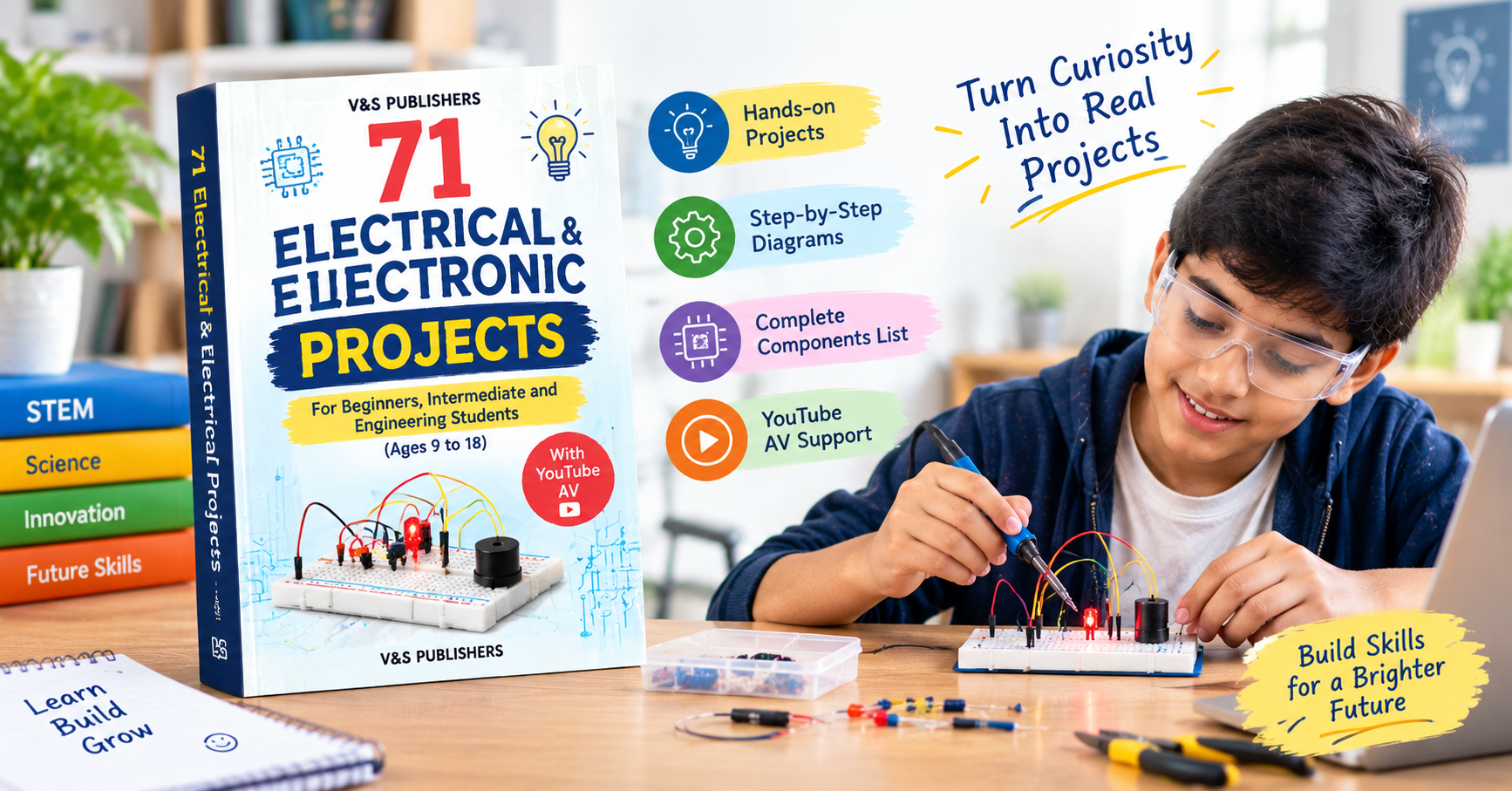
Every child asks “how does this work?” at some point. A torch, a doorbell, a fan, or a toy car—most of the time, the answer remains a mystery. This is the gap that a good STEM activity book can close, and it is exactly what 71 Electrical & Electronic Projects by V&S Publishers sets out to do.
This is not just another school science project book. It is a structured guide that takes learners from the basics of electrical circuits to real working models, with clear diagrams, a full components list, and simple theory behind every build.
Whether your child is preparing for a school science fair, a curious hobbyist is experimenting at home, or an engineering student wants practical circuit experience, this book is built to meet them at their current level.
This article explains what the book covers, why hands-on STEM learning matters for Indian students, how the projects are organised by difficulty, and how to use the book effectively at home or in a school laboratory.
What Is 71 Electrical & Electronic Projects About?
This book is part of V&S Publishers’ Student Development collection and is placed under the School Books category. It is written for beginners, intermediate learners, and engineering students who want to move from theory to practice.
The book does not send students directly into complex circuits. It starts with the fundamentals of electricity and electronics—the basic knowledge every learner needs before working with a breadboard.
Once that foundation is established, each project follows the same reliable format: a schematic diagram, a complete list of components, an explanation of the theory, and the actual steps required to make the project work.
The materials used in the projects are easy to find. Most components are available from local electronics or hardware shops and cost less than many parents expect.
Book at a Glance
| Book Detail | Information |
|---|---|
| Book Title | 71 Electrical & Electronic Projects (With YouTube AV) |
| Category | Student Development, filed under School Books |
| Subtitle | For beginners, intermediate and engineering students |
| Age Group | 9 to 18 years |
| Language | English |
| Pages | 232 |
| Binding | Paperback |
| Colour | Black and White |
| Price | Rs. 295 (about USD 15) |
| Publisher | V&S Publishers |
Why This Book Works for Every Kind of Learner
Most activity books focus on one age group. This book is arranged in three clear segments, allowing a Class 5 student and a first-year engineering student to use the same resource without feeling lost or bored.
For Beginners
Basic concepts such as current, voltage, resistance, and simple circuits are explained in plain language before the student begins building.
For Intermediate Learners
Projects gradually increase in complexity, supporting middle and high school students preparing working models for assignments and exhibitions.
For Engineering Students
More advanced circuits help first-year engineering students connect classroom theory with practical laboratory work.
For Hobbyists
Curious builders can practise interpreting schematics, understanding components, and assembling functional electronic projects.
Inside the Book: What You Actually Learn
Each of the 71 projects follows a consistent teaching method, which makes the book suitable for self-study.
The relevant electrical or electronic concept is introduced before the project begins.
A clear circuit diagram shows exactly how each component should connect.
Every required part is listed in advance, avoiding guesswork and last-minute shopping.
The book explains why the circuit behaves as it does, not only how to assemble it.
The student builds a working model and applies the concept covered in the preceding explanation.
This structure supports project-based learning, where students understand a concept by applying it directly rather than only reading about it in a textbook.
Project Segments at a Glance
| Segment | Best Suited For | Primary Focus |
|---|---|---|
| Beginner Level | Ages 9 to 13 and first-time builders | Basic circuits, simple concepts, and safety practices |
| Intermediate Level | Ages 13 to 16 and school science projects | Working models, sensors, and small electronic gadgets |
| Engineering Level | Ages 16 to 18, engineering students, and serious hobbyists | Applied circuits, component behaviour, and advanced schematics |
What Skills Does a Student Actually Build?
Building a circuit may appear to be one activity, but it develops several practical and academic skills at the same time.
Problem-Solving
A circuit that does not work encourages students to trace the fault step by step instead of immediately giving up.
Precision and Patience
Connecting the wrong component demonstrates the importance of careful observation and attention to detail.
Technical Diagram Reading
Learning to understand schematics makes subjects such as physics and engineering drawing less intimidating.
Cause-and-Effect Thinking
Changing a component and observing the result develops the habit of testing ideas scientifically.
Confidence With Tools
Breadboards, multimeters, soldering irons, and other basic tools become familiar through guided practice.
Practical Application
Students connect theoretical classroom concepts with working physical models and laboratory assessment.
These skills align with what NCERT and CBSE science curricula expect students to demonstrate through practical work and laboratory-based assessments.
A Quick Look at the Basics the Book Builds On
Before beginning a project, the book grounds students in several electrical concepts that appear repeatedly across circuits:
- Voltage is the push that moves electric current through a circuit and is measured in volts.
- Current is the flow of electric charge and is measured in amperes.
- Resistance controls how much current flows for a given voltage and is measured in ohms.
- Series and parallel circuits behave differently and explain why some connected devices dim together while others do not.
These concepts do not need to be memorised in isolation. Each one appears inside a project, allowing the explanation and the physical build to reinforce each other.
Textbook Learning vs Project-Based Learning
| Factor | Textbook-Only Learning | Project-Based Learning |
|---|---|---|
| Retention | Often short-term and based on memorisation | Longer-term learning through building and testing |
| Engagement | Can feel repetitive or dry | Hands-on and driven by curiosity |
| Application | The concept remains theoretical | The concept becomes a working physical model |
| Exam and exhibition readiness | Prepares students mainly for written answers | Prepares for written answers and working demonstrations |
| Confidence with tools | Provides little or no practical tool experience | Builds familiarity with tools and electronic components |
Simple Safety Habits Every Young Builder Should Know
Electrical Project Safety
- Always work under adult supervision when using a soldering iron or mains-powered device.
- Double-check the components list and schematic before connecting a power source.
- Keep the work area dry and free from loose metal pieces that could cause a short circuit.
- Begin new projects using low-voltage battery power before attempting anything connected to mains electricity.
- Disconnect the power source before changing any circuit connection.
These habits are as important as the projects themselves. The beginner section introduces this cautious approach from the start.
Why Hands-On Science and Electronics Projects Matter Right Now
Practical learning is now a policy priority in Indian education and connects directly with the direction of the employment market.
India’s National Education Policy 2020 promotes project work, internships, field visits, and hands-on activities so science education relies more on laboratory work and real-world experiments rather than passive learning.
According to the ASER Report 2023 , approximately 80 percent of students in India struggle with application-based questions. This highlights the need for more practical learning.
Reading about a circuit is very different from building it, testing it, finding a fault, and watching it light up or move.
India produces more than 1.5 million engineers and thousands of pure-science graduates every year. Its electronics and hardware sector is also experiencing rising demand for embedded-systems specialists, hardware engineers, and robotics professionals.
This demand is supported partly by new government incentive schemes for electronics and semiconductors . A student who begins building circuits at age 10 develops an early foundation in skills the electronics industry actively needs.
How This Book Fits Into School and Home Learning
Science Fair Projects
The intermediate segment helps students select a project, follow the schematic, collect affordable components, and create a working model.
Homework and Self-Study
Every project explains the “why” before the “how,” reducing the need for continuous supervision or technical support from parents.
Engineering Foundations
Students entering engineering programmes can use the projects for light, practical revision of concepts that often remain abstract in textbooks.
School Laboratory Support
Teachers can use the book as a ready-made STEM project bank because the diagrams and components lists reduce lesson-planning work.
How to Start Your First Project
- Read the fundamentals section first. Do not skip this section, even if the student is eager to begin building.
- Choose a beginner-level project. This is advisable even for older students completing their first electronics build.
- Create a shopping list. Use the supplied components list and check a local electronics shop before purchasing online.
- Study the schematic carefully. Understanding the circuit diagram is a major part of the learning process.
- Build slowly and test regularly. Test individual stages instead of assembling the entire circuit before checking it.
- Use the YouTube AV support. Watch the visual walkthrough when the printed diagram is not sufficient.
- Progress gradually. Move from beginner to intermediate projects and then to engineering-level builds.
Who Should Buy This Book?
- Parents looking for a genuine STEM project book rather than another toy marketed as educational.
- School teachers who need ready-to-use working models for science laboratories and exhibitions.
- Students aged 9 to 18 who want a structured path from basic electronics to advanced circuits.
- First-year engineering students who want practical experience alongside classroom coursework.
- Hobbyists curious about how electrical and electronic devices work.
Frequently Asked Questions
Is this suitable for a child with no electronics knowledge?
Yes. The book introduces electrical and electronics fundamentals before beginning the projects, making it suitable for complete beginners.
What age group is the book designed for?
It is designed for readers aged 9 to 18 and includes beginner, intermediate, and engineering-level projects.
Are the components expensive or difficult to find?
No. Most materials are commonly available from local electronics shops and are relatively affordable.
Does the book include video support?
Yes. It comes with YouTube AV support, allowing students to view demonstrations alongside the printed instructions and diagrams.
Can it help with school science fair projects?
Yes. The intermediate segment is particularly useful for science fairs because projects include schematics, components lists, and theory.
Do I need to buy tools before starting?
A screwdriver set, breadboard, and multimeter are useful, but most beginner projects only require the tools and components listed for that specific project.
How is this different from random online videos?
Online videos may jump directly to wiring. This book explains the fundamentals and theory first, while its YouTube support adds a visual layer to the structured explanation.
Can students from non-science streams use the book?
Yes. The book assumes no prior specialisation and teaches the fundamentals before moving into practical projects.
Final Thoughts
Good STEM learning does not require an expensive laboratory or advanced equipment. It needs a clear explanation, a reliable diagram, and an opportunity to build something with your own hands.
71 Electrical & Electronic Projects gives students exactly that at a price that makes practical electronics learning accessible to many households.
Explore V&S Publishers’ range of school and examination-preparation books , browse the complete book catalogue , learn more about the publisher on the About Us page , or visit the V&S Publishers homepage .