“Kill two birds with one stone,” in Hindi, “Ek teer se do shikar.” Most Hindi-speaking students know the meaning instantly, yet struggle to recall the exact English equivalent the moment they need it in an essay, interview, or competitive exam answer sheet.
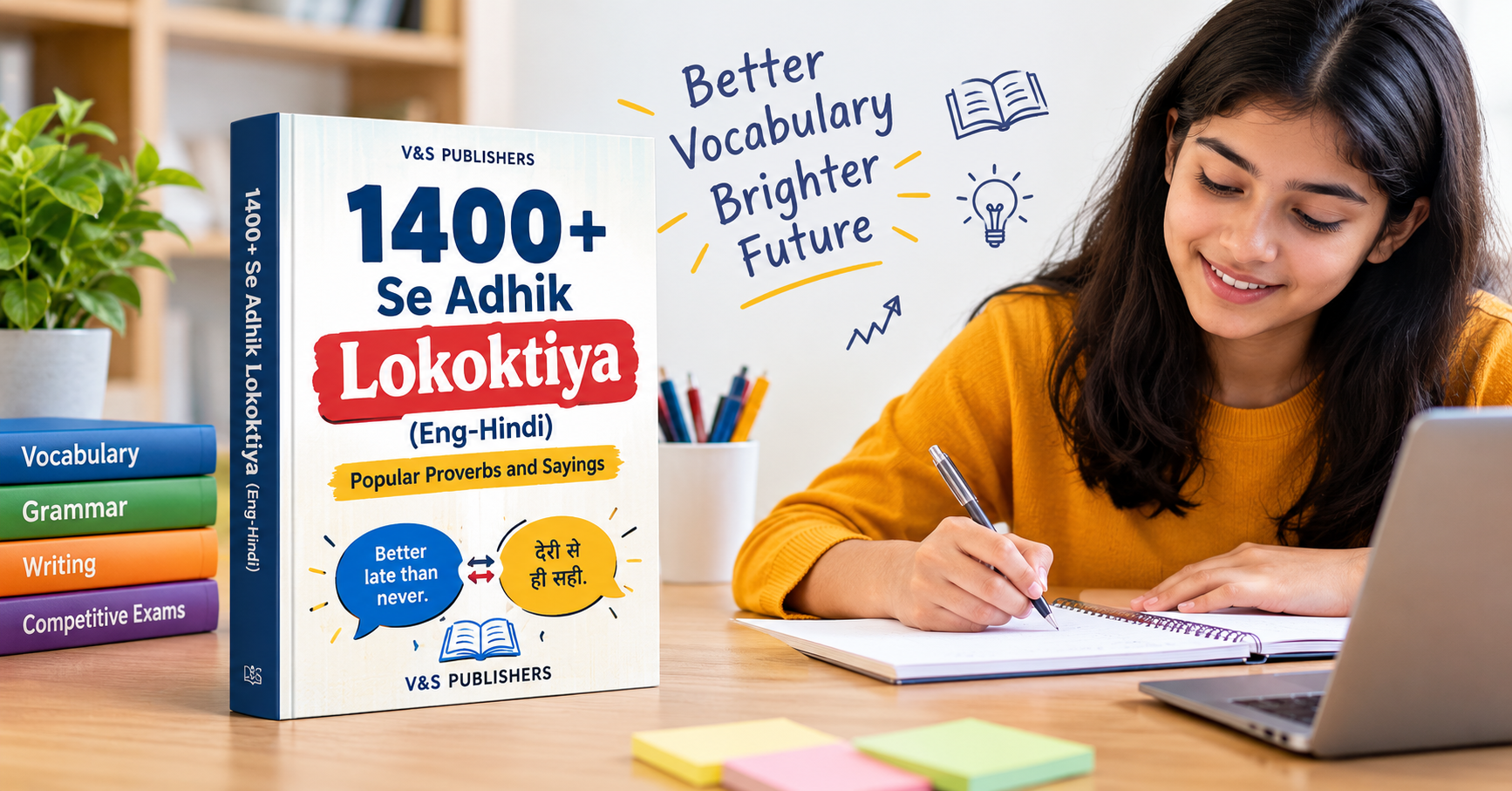
That single, everyday translation gap is exactly what 1400+ Se Adhik Lokoktiya (Eng-Hindi), published by V&S Publishers, is built to close.
This is a dictionary for students in the truest sense—a Hindi-English reference containing more than 1400 popular proverbs and sayings, compiled in a straightforward format for quick lookup. In this guide, we unpack what is inside the book, why idioms, phrases, and proverbs matter for English writing skills and competitive exam preparation, and how the book fits into a wider self-study English learning plan.
Why Proverbs and Idioms Still Decide English Fluency
English in India is often taught through grammar rules and vocabulary lists, yet fluency is judged on something else entirely: how naturally a person expresses an idea.
According to the 2024 English Proficiency Index , India scored 490 out of 800 points, placing the country in the moderate proficiency band and 69th globally. Certain cities, including Jaipur, Mumbai, and Kochi, scored far above the national average, while several other states scored well below it.
That gap between reading English and speaking or writing it naturally is precisely where an idioms, phrases, and proverbs book earns its place on a student’s desk.
Competitive exams have only raised the stakes. Every year, more than three crore students in India attempt some form of competitive examination after Class 10. English—including grammar, vocabulary, and comprehension—is treated as a mandatory section across most national and state-level exams.
English Proficiency and Exam Landscape at a Glance
| Data Point | Figure | Source |
|---|---|---|
| India’s English Proficiency Index score (2024) | 490 out of 800 | EF English Proficiency Index |
| India’s global EPI rank (2024) | 69th | EF English Proficiency Index |
| Students attempting competitive exams after Class 10 annually | 3+ crore | Education industry data |
| Share of Indians who speak English at all | Roughly 1 in 10 | EF English Proficiency Index |
| Total proverbs and sayings covered | 1400+ | V&S Publishers |
| Recommended age group | 13 to 18 years | V&S Publishers |
Inside 1400+ Se Adhik Lokoktiya: What This Dictionary Offers
The book’s subtitle says it plainly: Popular Proverbs and Sayings. Rather than being a general English grammar and usage book, it is a focused Hindi-to-English reference built for one job: giving a student, teacher, or professional the exact English proverb or phrase that matches a Hindi expression.
Book Snapshot
| Book Detail | Information |
|---|---|
| Book Title | 1400+ Se Adhik Lokoktiya (Eng-Hindi) |
| Subtitle | Popular Proverbs and Sayings |
| Publisher | V&S Publishers |
| Category | Dictionaries |
| Age Group | 13 to 18 years |
| Published Language | Hindi |
| Binding | Paperback |
| Colour | Black and White |
| Pages | 132 |
| Price | Rs. 250 (approx. USD 12) |
| Format | Straightforward reference layout for quick lookup |
Because the content is organised for reference rather than narrative reading, it works well alongside a general English grammar and usage book, a synonyms and antonyms book, or a full dictionary for students, rather than replacing them.
Readers can compare it with other titles on the dictionaries and reference collection page.
A Few Examples of Lokoktiya in Action
To show how the dictionary’s format works, here are a few common Hindi proverbs alongside their natural English equivalents—the same style of entry used throughout the book.
| Hindi Lokokti | Literal Meaning | Natural English Equivalent |
|---|---|---|
| Ek teer se do shikar | One arrow, two prey | Kill two birds with one stone |
| Boond boond se ghara bharta hai | The pot fills drop by drop | Little strokes fell great oaks |
| Andhon mein kana raja | Among the blind, the one-eyed is king | In the land of the blind, the one-eyed man is king |
| Jaisi karni waisi bharni | As the deed, so the return | As you sow, so shall you reap |
| Sau sunar ki, ek lohar ki | A hundred blows of a goldsmith equal one of a blacksmith | One strong blow is worth a hundred weak ones |
| Nach na jaane aangan tedha | One who cannot dance blames the crooked courtyard | A bad workman blames his tools |
Entries like these are why the book functions as more than a novelty phrase list. Each pairing captures a genuine shift in phrasing, tone, and cultural reference rather than providing a stiff, literal conversion.
How Lokoktiya Bridge Hindi and English Communication
A lokokti, or proverb, carries meaning that a literal, word-for-word translation almost always loses. “Ek teer se do shikar” translates directly to something like “one arrow, two prey,” which sounds unnatural in English.
The idiomatic equivalent, “kill two birds with one stone,” lands instantly with a native or fluent English speaker. This is the core translation skill the dictionary is built around: not literal conversion, but equivalent meaning.
This matters beyond the classroom. Business communication, official drafting, letter writing, and everyday English conversation all rely on idiomatic fluency rather than textbook-perfect grammar.
The Research-Backed Case for Learning Idioms and Proverbs
Academic research on second-language learning supports what teachers often observe: strong knowledge of proverbs leads to more fluent and natural language production. This fluency can also increase a learner’s motivation to continue engaging with the language.
Industry analysis of classroom outcomes has reported that learners who actively use idioms and proverbs improve their speaking and writing performance by around 30 percent, build vocabulary roughly 25 percent faster through daily use, and experience reading and writing comprehension gains of approximately 20 percent when idiom exposure is paired with structured teaching materials.
Language-learning research also identifies repetition and retrieval practice as fundamental strategies for long-term retention. A compact proverbs dictionary supports this through repeated, quick-reference use.
Reported Learning Gains From Idiom and Proverb Practice
| Skill Area | Reported Improvement | Context |
|---|---|---|
| Speaking and writing performance | Around 30% | Learners actively using idioms and proverbs |
| Vocabulary growth | Around 25% | Daily idiom use |
| Reading and writing comprehension | Around 20% | Structured idiom exposure |
| Motivation to continue learning | Increases | Linked to proverb and idiom fluency |
Why This Dictionary Matters for Competitive Exam Preparation
Competitive exam English sections rarely ask a candidate to define a word in isolation. Instead, they test usage: filling in the correct idiom, identifying the meaning of a phrase in context, or writing an essay that reads naturally rather than appearing mechanically translated.
A book built around more than 1400 commonly used proverbs gives aspirants a large reference bank for this kind of question, whether they are preparing for a school-level English paper, a bank or government recruitment test, or an English component of a university entrance examination.
The book also remains relevant beyond school. Idiomatic English does not change dramatically between a Class 10 essay and a corporate email.
Examiners often reward candidates who can use a proverb correctly in context rather than simply define it. Context-based usage is a stronger signal of genuine comprehension than a memorised definition.
Age-Appropriate Learning: Why 13 to 18 Years Is the Right Window
The 13 to 18 years age range aligns with two major transitions in a student’s English education. Around age 13, students move from basic grammar exercises toward comprehension and composition, where idiomatic phrases begin to matter for scoring well.
By age 18, many students are preparing for board examinations, entrance tests, or their first English proficiency assessments, all of which reward natural, idiomatic expression over literal, word-for-word writing.
Because the book is organised as a quick reference rather than a graded course, older students can use it selectively for exam revision. Younger students can progress more slowly by learning a few new proverbs at a time.
How This Book Compares to General English Reference Titles
Many students already own a general grammar guide or a synonyms and antonyms book. A focused proverbs dictionary complements those resources instead of duplicating them.
| Feature | 1400+ Se Adhik Lokoktiya | Typical General English Reference Book |
|---|---|---|
| Core focus | Proverbs and sayings, Hindi to English | Grammar rules, vocabulary lists, or general usage |
| Best used for | Idiom recall, translation, and exam writing | Sentence construction, spelling, and grammar accuracy |
| Format | Straightforward, quick-lookup reference | Often chapter-based with exercises |
| Bilingual support | Hindi and English side by side | Usually English only |
| Ideal pairing | Alongside a grammar book or dictionary | Alongside an idioms or proverbs supplement |
| Price point | Rs. 250 (approx. USD 12) | Comparable or higher for similar page counts |
Practical Ways to Use This Dictionary: A Simple Study Plan
- Start with familiar Hindi proverbs. Look up sayings the student already uses in daily conversation. Recognising the English equivalent builds confidence faster than starting with unfamiliar entries.
- Practise active recall, not passive reading. Cover the English side, try to recall it from the Hindi lokokti, and then check the answer.
- Apply proverbs in writing immediately. Use two or three new proverbs in that week’s essay, letter, or practice answer.
- Group similar meanings together. Organise proverbs around themes such as patience, effort, consequence, and success.
- Revisit the material weekly. Spaced review builds stronger long-term recall than a single read-through.
Who Should Buy This Book?
School Students
Students aged 13 to 18 preparing for composition, essay writing, and comprehension sections receive an exam-ready bank of natural English proverbs.
Competitive Exam Aspirants
Candidates preparing for bank, government, school-level, or university entrance examinations can strengthen idiom usage and comprehension.
Teachers
Teachers receive a ready-made collection of bilingual examples instead of having to compile lists manually.
Working Professionals
Professionals can improve business communication, official drafting, formal correspondence, and natural English expression.
Competitive exam aspirants may also pair the book with V&S Publishers’ Olympiad preparation guides for broader English and reasoning preparation.
About V&S Publishers
1400+ Se Adhik Lokoktiya is published by V&S Publishers , a Delhi-based educational publishing house active since the 1940s.
The publisher’s catalogue spans more than 2,000 titles across over 100 subjects and nine languages. Dictionaries and reference titles form one of its core categories alongside school support, Olympiad preparation, and children’s learning.
The publishing house has been recognised at industry events, including a Federation of Indian Publishers award for excellence in book production.
Frequently Asked Questions
How many proverbs and sayings does this dictionary cover?
The book covers more than 1400 popular proverbs and sayings, translated and matched between Hindi and English.
Who is this book meant for?
It is designed for students aged 13 to 18, along with teachers and anyone developing stronger Hindi-to-English translation skills.
Is this a general English grammar book?
No. It is a specialised dictionary-style reference focused on proverbs and sayings. It is intended to complement a general grammar book.
Can this book help with competitive exam preparation?
Yes. Its large bank of natural, idiomatic proverbs supports exam writing, usage-based questions, and comprehension tasks.
Does it help with business communication and formal writing?
Yes. It provides accurate English equivalents for common Hindi expressions that can support formal correspondence and natural communication.
How is it different from a synonyms and antonyms book?
A synonyms and antonyms book compares individual words. A proverbs dictionary matches complete expressions and their cultural meanings.
Final Thoughts
Between India’s developing average English proficiency and the number of students competing in examinations every year, natural and idiomatic fluency has become a genuine differentiator rather than simply a useful additional skill.
1400+ Se Adhik Lokoktiya gives students, teachers, and professionals a focused, easy-to-use way to close the gap between thinking in Hindi and writing or speaking naturally in English.
For anyone looking for a dictionary for students, an idioms and proverbs book, or an addition to their competitive exam English preparation shelf, this title offers a large proverb collection, a bilingual quick-reference format, and the backing of a publisher with more than eight decades of educational publishing experience. Explore the full range on the V&S Publishers homepage .