Who invented the light bulb? Who discovered that the earth goes around the sun? Who split the atom, and who found cures for so many diseases? Behind every major idea in science, there is a person.
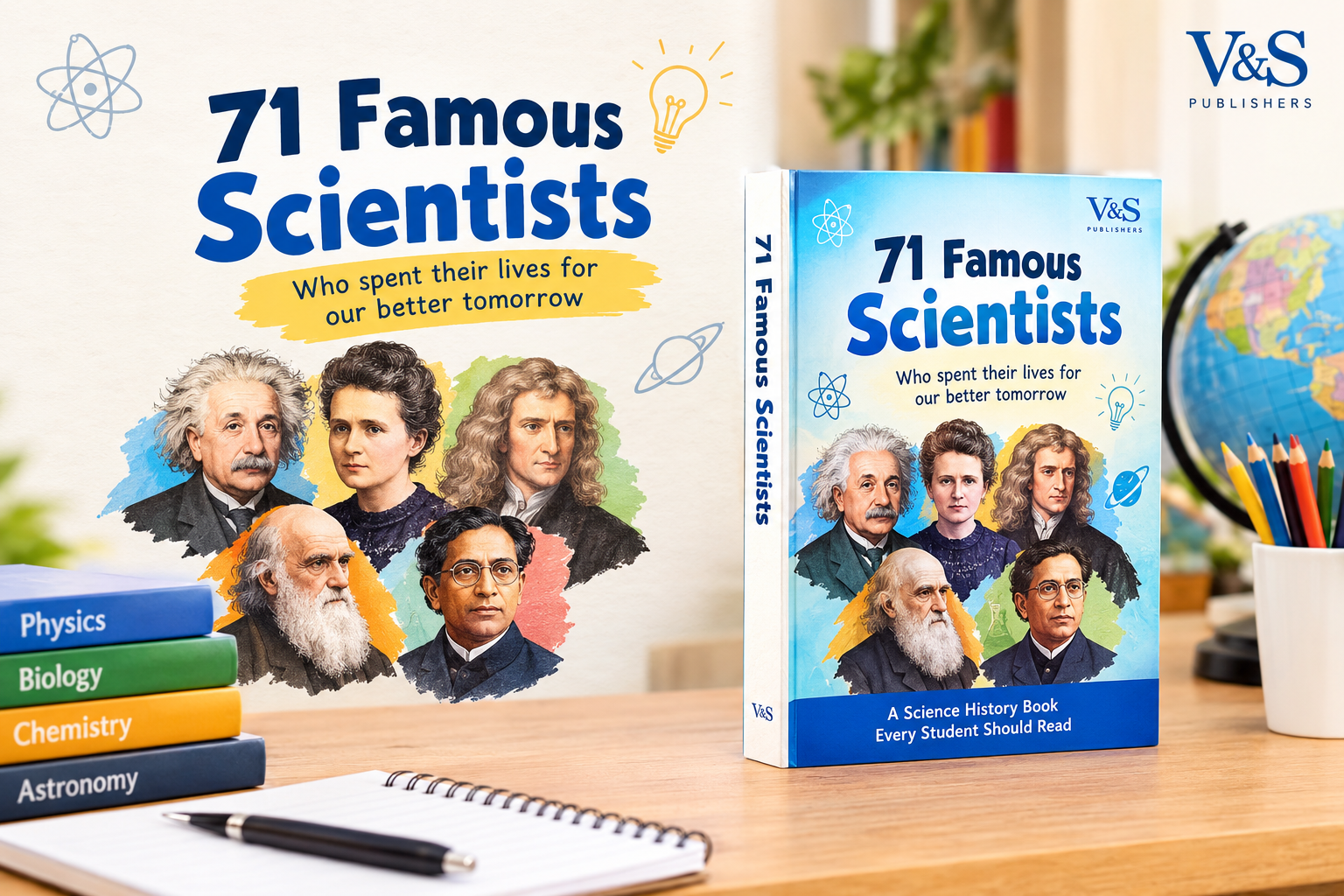
71 Famous Scientists, published by V&S Publishers , brings together the life stories of 71 such people. It is a simple, honest, and easy-to-read biography book that shows young readers how science really grows: through hard work, curiosity, and the courage to ask “why.”
This book is part of the popular 71 Series from V&S Publishers, which also includes titles such as 71 Science Experiments, 71+10 New Science Projects, and 71+10 Magic Tricks for Children. Like its sister titles, the book is designed to make learning feel enjoyable rather than like homework.
Quick Answer: What Is 71 Famous Scientists About?
71 Famous Scientists is a 160-page paperback biography book that tells the life stories of 71 scientists and inventors from around the world. It covers their childhood, struggles, major discoveries, and how their work changed everyday life.
The book carries the subtitle “Who spent their lives for our better tomorrow” and is written for students and young readers who want to understand the people behind science, rather than only the facts presented in their textbooks.
Book Snapshot
| Book Detail | Information |
|---|---|
| Book Name | 71 Famous Scientists |
| Subtitle | Who spent their lives for our better tomorrow |
| Category | Biographies / Children’s Books |
| Publisher | V&S Publishers |
| Language | English |
| Binding | Paperback |
| Pages | 160 |
| Print Style | Black and White |
| Price | Rs. 250 (approx. USD 12) |
| Best Suited For | Students aged 11 to 20 years |
Why Scientist Biographies Matter for Students
Most science textbooks teach the rule, formula, or law. They rarely stop to tell the complete story of the person who discovered it. This is where 71 Famous Scientists fills a meaningful gap.
When students read that Isaac Newton was once a quiet farm boy, or that Marie Curie worked for years in a cold shed to isolate radium, the discovery stops being another fact to memorise. It becomes a story about patience, failure, and eventual success.
Builds Interest in Science
Connecting with a scientist’s struggles and discoveries can make the subject more engaging than memorising isolated facts.
Supports Projects and GK
Biography-based questions regularly appear in school assignments, general knowledge tests, and quiz competitions.
Helps Olympiad Preparation
Students learn to connect discoveries with scientists, historical periods, and scientific fields.
Shows Diversity in Science
Stories from different countries and centuries provide a wider, more inclusive view of scientific progress.
Develops Reading Skills
Short biographies use simple, story-based language that supports vocabulary development and regular reading habits.
What Kind of Scientists Does the Book Cover?
A book with the scope of 71 Famous Scientists provides a wide view of science history rather than focusing on only one field. Readers can expect stories from physics, chemistry, biology, medicine, astronomy, and engineering.
Globally recognised names include Isaac Newton, Galileo Galilei, Charles Darwin, Albert Einstein, Marie Curie, Thomas Edison, and the Wright Brothers.
For Indian readers, the book also connects with scientists such as C.V. Raman, Jagadish Chandra Bose, and Homi Bhabha. This combination connects global science history with names students may already recognise from textbooks and school assemblies.
How the 71 Series Makes Learning Simple
71 Famous Scientists belongs to the V&S Publishers 71 Series, a collection designed to provide a useful amount of knowledge in an accessible, easy-to-carry format.
- 71 Science Experiments: hands-on learning activities for use at home.
- 71+10 New Science Projects: working models for school projects and exhibitions.
- 71+10 New Science Projects Junior: simplified projects for younger students.
- 71+10 New Science Activities: classroom and holiday learning activities.
- 71+10 Magic Tricks for Children: screen-free learning and entertainment.
A child inspired by a scientist’s life story may naturally want to continue learning through the experiments and project books in the same series.
Meet a Few Famous Scientists
These examples show why scientist biographies stay with young readers: each scientific achievement is connected to a person, a struggle, and a lesson.
Isaac Newton
Newton grew up on a farm in England and was not initially considered an exceptional student. His questions about gravity, motion, and light later helped form the foundation of modern physics.
Marie Curie
Curie overcame financial hardship and restrictions on women’s education to win Nobel Prizes in both Physics and Chemistry. Her work on radioactivity continues to influence medicine.
Charles Darwin
Darwin spent five years travelling aboard the HMS Beagle, carefully gathering plants, animals, and fossils before developing his theory of evolution.
Jagadish Chandra Bose
Working in Kolkata with limited funding, Bose built his own instruments and demonstrated that plants respond to stimuli. His story highlights India’s contribution to global science.
Albert Einstein
Einstein worked in a patent office while developing ideas that became the theory of relativity. His journey shows that groundbreaking thinking can happen outside a traditional academic role.
Common Myths Scientist Biographies Help Correct
Textbooks often show only the final discovery, not the years of failed attempts and uncertainty that came before it. Scientist biographies provide a more realistic view of how scientific progress happens.
Myth: Every Scientist Was a Top Student
Many well-known scientists, including Newton and Einstein, were viewed as average or weak students at certain points in their education.
Myth: Discoveries Happen Instantly
Discoveries such as evolution and radioactivity required years of observation, experimentation, and repeated work.
Myth: Science Needs Expensive Labs
Scientists such as Jagadish Chandra Bose built their own instruments and still produced globally respected research.
Myth: Science History Belongs Only to Men
Stories of scientists such as Marie Curie help students recognise the contribution of women to scientific progress.
Why This Book Works for Ages 11 to 20
The 11-to-20 age range covers a wide period of school and early college life. Younger readers receive an accessible introduction to important scientific figures through short, readable chapters.
Older students preparing for board examinations, entrance tests, or competitive exams receive a quick reference for “who discovered what” questions that often appear in general knowledge sections.
- A supplementary reader alongside the school science syllabus.
- A general knowledge reference for quiz clubs and Olympiad preparation.
- An affordable gift book for scientifically curious readers.
- A useful school library addition suitable for short or chapter-by-chapter reading.
What Readers Usually Take Away
More Than Names and Discoveries
The real value lies in recognising the pattern behind scientific progress: curiosity that refuses to stop, failure treated as a lesson, and the belief that one honest question can eventually change the world.
This is what the subtitle promises—these are people “who spent their lives for our better tomorrow.”
Tips for Parents and Teachers
Biography books work best when they are used actively instead of being read once and placed back on a shelf.
- Read one chapter each day. Short, regular sessions help students remember the stories more effectively.
- Ask “What would you have done?” This encourages reflection instead of simple factual recall.
- Connect stories to the school syllabus. Match a scientific law or discovery with the relevant scientist’s biography.
- Use the book for GK and quizzes. Review scientists and their discoveries before school competitions and Olympiad examinations.
- Pair each story with an experiment. Follow a biography with a related hands-on activity from the V&S science-project series.
Frequently Asked Questions
Who is 71 Famous Scientists written for?
It is written mainly for students aged 11 to 20, including school students, Olympiad aspirants, and young readers who enjoy biographies and general knowledge books.
Is 71 Famous Scientists part of a series?
Yes. It belongs to V&S Publishers’ 71 Series, which also includes science experiment books, science project books, and activity books for children.
How many pages does the book have?
The book has 160 black-and-white pages in paperback binding.
What language is the book available in?
The book is published in English.
Does the book only cover scientists from one country?
No. It covers well-known scientists and inventors from around the world, alongside notable Indian scientists.
Is this useful for Olympiad or GK preparation?
Yes. It supports questions about scientists, their discoveries, and their periods of work. It can be used alongside dedicated Olympiad preparation books .
What is the price of the book?
The book is priced at Rs. 250 (approximately USD 12).
Where This Book Fits in the V&S Catalogue
71 Famous Scientists sits within V&S Publishers’ Children’s Books category , which includes illustrated and engaging titles created to develop curiosity in young readers.
It shares the catalogue with titles such as the Children’s Big Book of Activities and Legends of India .
Students can also explore V&S Publishers’ Olympiad books covering Mathematics, Science, English, and General Knowledge for Classes 1 to 12, along with reference titles such as the World Atlas .
Learn more about the publisher on the About V&S Publishers page, explore its distribution network , or browse the V&S Publishers Amazon store .
Learn More About the Scientists Inside
Readers who want to explore individual scientists in greater depth can use trusted reference sources. The Nobel Prize official website provides information about scientists such as Marie Curie and Albert Einstein.
Readers interested in astronomy and space-science pioneers can also explore NASA’s history pages . These resources are useful for older students and parents supporting school projects.
Final Word
71 Famous Scientists does something simple but important: it turns textbook facts into human stories. Formulas become easier to remember when there is a face and a journey behind them, and curiosity grows when students see that every major discovery began with someone asking a small, honest question.
At Rs. 250 for 160 pages, it is an accessible way to bring science history into a student’s reading list—whether for school, Olympiad preparation, general knowledge, or simply the enjoyment of a true story.