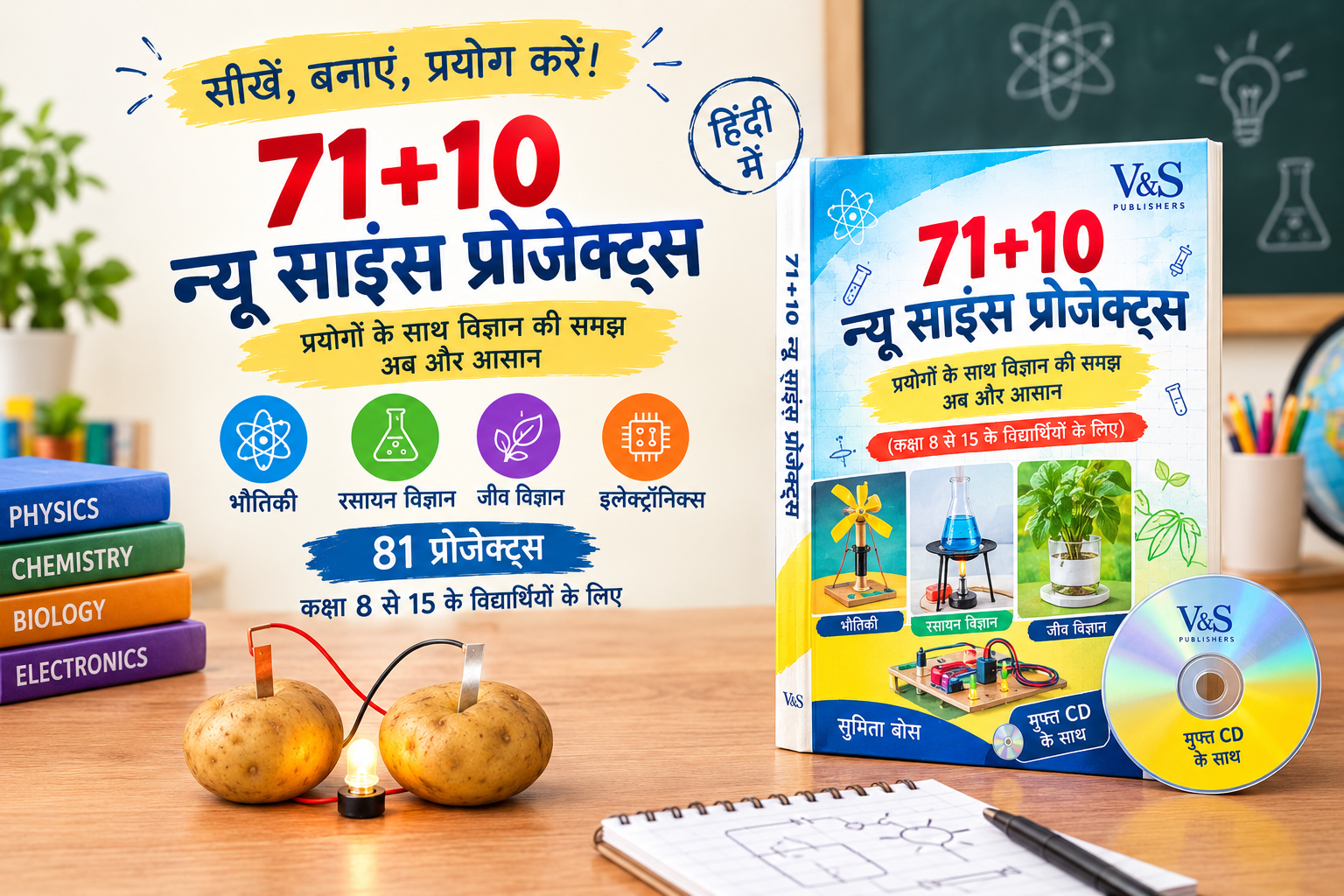
Verify classroom knowledge with experiments, in Hindi, for students aged 8 to 15.
A physics teacher hands out a project assignment and gives no starting point. A science exhibition is three weeks away and the student wants a chemistry model nobody else will bring. A curious child simply wants to know how a potato can light a small bulb.
These are the exact moments 71+10 New Science Projects, published by V&S Publishers, was written for—and it answers them in Hindi.
This revised edition brings together 81 classroom-tested projects across physics, chemistry, biology and electronics. The projects are explained in simple Hindi so that language is never a barrier between a student and a working science model.
This guide examines what the book contains, why a Hindi-language science activity book matters for Indian students, and how its projects support school science fairs and exhibitions.
Why a Hindi Science Activity Book Matters
English-medium instruction has grown in India, but it has not replaced Hindi-medium schooling. Government survey data compiled by the Ministry of Human Resource Development shows that children studying in Hindi medium constitute a little over 50 percent of all children enrolled at the primary level.
For a very large share of Indian students, Hindi is not a secondary language of learning. It is the language in which science first makes sense.
The National Education Policy 2020 supports this approach. The policy states that young children understand non-trivial concepts, including mathematics and science, more quickly when taught in their home language or mother tongue.
It recommends mother-tongue or regional-language instruction until at least Grade 5, and preferably until Grade 8 and beyond. A science activity book that explains experiments in Hindi therefore provides meaningful access to scientific reasoning for Hindi-medium students.
Quick Data Snapshot
| Statistic | Figure | Source |
|---|---|---|
| Children in Hindi medium at primary level, Classes 1 to 5 | Over 50% | Ministry of HRD, cited in Parliament |
| Children in Hindi medium at upper-primary level, Classes 6 to 8 | About 45% | Ministry of HRD, cited in Parliament |
| Recommended mother-tongue instruction period | Until Grade 5, preferably Grade 8 and beyond | National Education Policy 2020 |
| Total activities in 71+10 New Science Projects | 81 | V&S Publishers |
| Subjects covered | Physics, Chemistry, Biology and Electronics | V&S Publishers |
| Recommended age group | 8 to 15 years | V&S Publishers |
| Pages | 136 | V&S Publishers |
Inside 71+10 New Science Projects
The book is designed for students who have received a project assignment and do not know where to begin, or who want to stand out at a science exhibition with a working model instead of a poster.
It is aimed at Secondary and Senior Secondary students within the 8-to-15 age range that covers much of Indian school science-fair participation.
Book Snapshot
| Book Title | 71+10 New Science Projects |
| Subtitle | Verify classroom knowledge with experiments, in Hindi |
| Category | Popular Science, Children's Books |
| Language | Hindi |
| Age Group | 8 to 15 years |
| Binding | Paperback |
| Colour | Black and White |
| Pages | 136 |
| Price | Rs. 250 (approximately USD 12) |
| Extras | Supplementary content included with the revised edition |
| Publisher | V&S Publishers |
Each project follows a structure suitable for self-study: a simple explanation of the scientific concept in Hindi, a list of easily available materials, and clear steps that lead to a demonstrable result.
The book also concludes with additional project ideas so that students who complete the core 81 activities have more concepts to explore.
Readers can explore related activity books through the Children's Books category or browse the complete V&S Publishers catalogue .
Five Signature Science Projects
Five highlighted projects provide a clear picture of the book's range across physics, electronics, chemistry and communication technology.
Automatic Electric Alarm
A basic circuit-design project showing how an electrical trigger can complete a circuit and sound an alarm. It introduces switches, current flow and basic sensor logic.
Railway Signal Model
A working railway-signal model that connects electrical circuits with a familiar real-world system, making wiring diagrams concrete and visible.
Astronomical Telescope
Building a telescope introduces lenses, focal length and magnification while allowing students to construct an instrument that brings distant objects closer.
Producing Electricity From Potatoes
Two dissimilar metal electrodes inserted into a potato create a small voltage through an electrochemical reaction, demonstrating how basic batteries work.
Making the Morse Code
Students build a simple signalling device and learn how dots and dashes carried messages across long distances before modern telecommunications.
These projects introduce electronics, optics, chemistry and communication technology, demonstrating the broad range covered by the book's 81 activities.
How the Book Is Organised Across Four Subjects
Physics Projects
Mechanics, optics and simple machines are explained through models that students build themselves, connecting textbook formulas with visible results.
Chemistry Projects
Safe, classroom-appropriate demonstrations turn abstract chemical concepts into models that students can display and explain at science fairs.
Biology Projects
Life-science activities help students visualise processes and structures that are usually presented only through textbook diagrams.
Electronics Projects
Circuit-based activities such as the electric alarm, railway signal and Morse code device introduce students to practical electrical systems.
Why Hands-On Science Matters for Indian Students
Practical, project-based learning is now a stated priority in Indian education policy rather than an optional extra. NEP 2020 encourages experiential and hands-on learning at school level.
CBSE also encourages schools to treat science and mathematics laboratory work as an important part of internal assessment instead of a separate side activity.
A book containing 81 ready-to-use projects reduces one of the biggest obstacles teachers and parents face: knowing where to start. Students receive a structured sequence of projects with materials lists, explanations and construction steps in the language in which they are most comfortable learning.
Textbook Learning vs Project-Based Learning
| Factor | Textbook-Only Learning | Project-Based Learning |
|---|---|---|
| Retention | Often short-term and based on memorisation | Reinforced through building and observing results |
| Engagement | Can feel repetitive across different subjects | Hands-on and varied, spanning physics to electronics |
| Language access | May assume comfort with English scientific terms | Explained in Hindi, reducing a key learning barrier |
| Exhibition readiness | Prepares mainly for written answers | Prepares working models for live demonstrations |
| Subject breadth | Usually one subject per textbook | Covers physics, chemistry, biology and electronics |
Why the 8 to 15 Age Range Works
At age eight, students generally have enough reading comprehension and fine-motor ability to attempt simple projects with guidance. By age fifteen, students can handle more demanding projects and understand the underlying scientific concepts instead of only following the construction instructions.
Ages 8 to 11: Simple visual activities such as the potato battery experiment build early curiosity and confidence.
Ages 11 to 13: Circuit-based projects such as the Morse code device and railway signal model support middle-school science assignments.
Ages 13 to 15: Advanced projects such as the astronomical telescope and electric alarm support science exhibitions and practical schoolwork.
How to Use This Book for a Science Fair Project
- Read the Hindi explanation first. Understanding the scientific concept is more important than immediately beginning construction.
- Check the materials list. Most projects use items that are already available at home or can be purchased from a local shop.
- Choose a project that matches the student's grade. Younger students can start with the potato battery, while older students can attempt the telescope or electric alarm.
- Use the supplementary content. The supporting material can be used alongside the printed instructions for additional guidance.
- Practise explaining the model. Science-exhibition judges generally reward students who can explain why their project works, not only demonstrate that it works.
- Explore the additional ideas. After completing the core projects, students can use the bonus section to discover further activities.
Comparison With Typical Activity Books
| Feature | 71+10 New Science Projects | Typical Activity Book |
|---|---|---|
| Number of projects | 81 | 20 to 40 |
| Subjects covered | Physics, Chemistry, Biology and Electronics | Usually one or two subjects |
| Language | Hindi | Mostly English only |
| Bonus content | Supplementary content and additional project ideas | Rarely included |
| Format | Explanation, materials list and clear steps | Often text-heavy |
| Price point | Rs. 250 (approximately USD 12) | Comparable or higher |
| Publisher legacy | V&S Publishers, active since the 1940s | Varies widely |
Who Should Buy This Book?
About V&S Publishers
71+10 New Science Projects is published by V&S Publishers , a Delhi-based educational publishing house active since the 1940s.
Its catalogue spans more than 2,000 titles across over 100 subjects and nine languages, including a Hindi-language collection developed for Indian classrooms.
The publishing house has received recognition at industry events, including a Federation of Indian Publishers award for excellence in book production. It continues to expand its STEM and activity-book range for students preparing for school exhibitions and practical assessments.
Frequently Asked Questions
What language is this book written in?
The book is written entirely in Hindi, making scientific concepts accessible to Hindi-medium students.
What age group is the book designed for?
It is designed for students aged 8 to 15 years, covering Secondary and Senior Secondary levels.
How many projects does the book include?
The book contains 81 projects across physics, chemistry, biology and electronics, plus a section of additional project ideas.
Does the book include supplementary content?
Yes. The revised edition includes supplementary material alongside the printed project instructions.
Is this book useful for school science fairs?
Yes. Projects such as the astronomical telescope, automatic electric alarm and railway signal model are well suited to science exhibitions.
Are the materials expensive or difficult to find?
No. The projects use materials that are generally available at home or from a local shop.
Can younger children use this book independently?
Students aged 8 to 10 may require light adult supervision for electronics activities, while older students can generally follow the projects independently.
Does the book cover more than one science subject?
Yes. It covers physics, chemistry, biology and electronics together in one volume.
Final Thoughts
For a large share of Indian students, science is learned first and best in Hindi. 71+10 New Science Projects addresses this need with 81 classroom-tested activities across four subjects, explained in accessible language and supported by supplementary content.
For parents and teachers looking for Hindi science project books, this title offers broad subject coverage, exhibition-ready projects and the backing of a publisher with more than eight decades of experience in Indian education.