Most people turn to alternative therapy books at a specific moment: a doctor has run out of clear answers, a chronic ache will not fully go away, or ordinary stress has started affecting daily life.
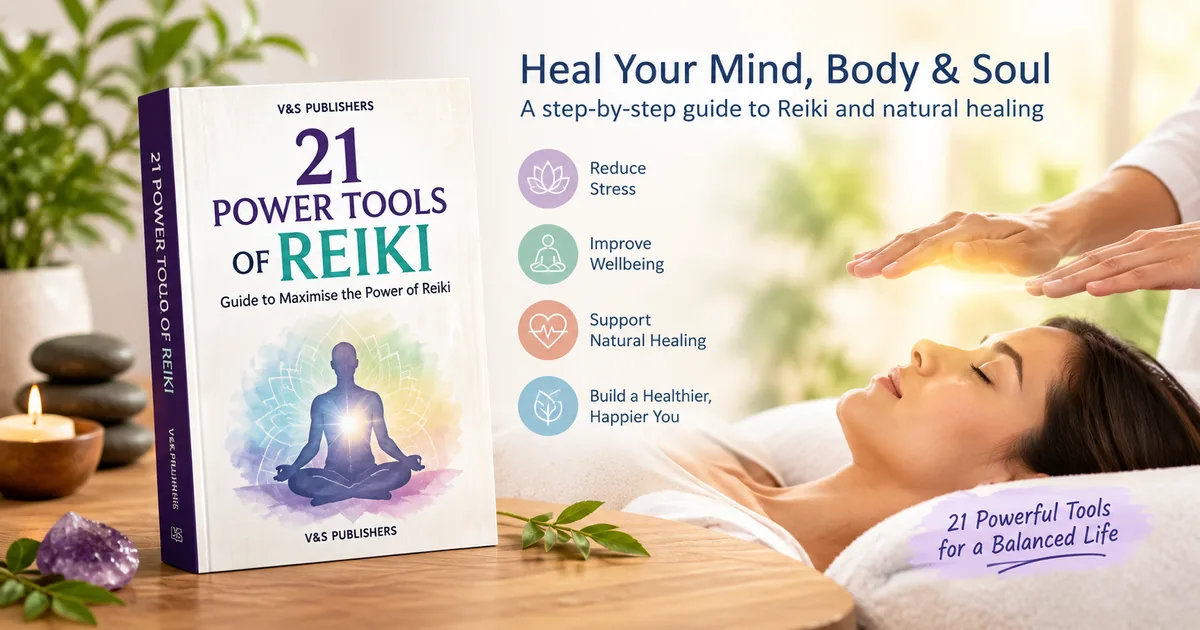
21 Power Tools of Reiki, published by V&S Publishers, speaks directly to that moment. It is a step-by-step guide to using Reiki with intention, built around 21 specific tools rather than a single, generic technique.
This article walks through what Reiki actually is, what is inside this particular book, and, just as importantly, what current scientific research says about Reiki so readers can approach the practice with realistic expectations.
Along the way, we will look at how Reiki fits into the much larger world of natural healing methods, holistic health for beginners, and the growing global market for alternative therapy.
What Is Reiki, and Why Are More People Trying It?
Reiki is a complementary health approach in which a practitioner places their hands lightly on or just above a person’s body, with the stated goal of directing energy to support the person’s own healing response.
According to the National Center for Complementary and Integrative Health , part of the U.S. National Institutes of Health, this practice is based on an Eastern belief in an energy that supports the body’s natural healing abilities.
Interest in this kind of mind-body wellness guide has grown sharply worldwide. Recent industry analysis drawing on U.S. government health survey data notes that roughly 37 percent of American adults now use some form of complementary health approach.
Yoga use reached 15.8 percent and meditation reached 17.3 percent as of 2022. NCCIH research also found that among adults using any complementary approach, the share using it specifically for pain management rose from 42.3 percent in 2002 to 49.2 percent in 2022.
Complementary Health Approaches: Quick Data Snapshot
| Statistic | Figure | Source |
|---|---|---|
| U.S. adults using at least one complementary health approach | Approximately 37% | NCCIH-backed industry data |
| Adults using complementary approaches for pain in 2022 | 49.2% | NCCIH, National Health Interview Survey |
| Adults using complementary approaches for pain in 2002 | 42.3% | NCCIH, National Health Interview Survey |
| Adult yoga use in 2022 | 15.8% | National Health Interview Survey |
| Adult meditation use in 2022 | 17.3% | National Health Interview Survey |
| Global complementary and alternative medicine market in 2025 | USD 200 billion+ | Industry market research |
| Recommended age group for 21 Power Tools of Reiki | 18 to 45 years | V&S Publishers |
Inside 21 Power Tools of Reiki: What This Book Covers
The book’s subtitle sums up its ambition: Guide to Maximise the Power of Reiki. Rather than a broad introduction to energy healing in general, it is described as the outcome of five years of research, compiling specific methods and tools that concentrate on the flow of energy for particular purposes.
Book Snapshot
| Book Detail | Information |
|---|---|
| Book Title | 21 Power Tools of Reiki |
| Subtitle | Guide to Maximise the Power of Reiki |
| Publisher | V&S Publishers |
| Category | Health and Fitness, Alternative Therapy |
| Age Group | 18 to 45 years |
| Language | English |
| Binding | Paperback |
| Colour | Black and White |
| Pages | 131 |
| Price | Rs. 295 (approx. USD 20) |
| Research Basis | Five years of compiled Reiki methods and tools |
According to its description, the book outlines tools intended for different occasions. It shows readers how to use Reiki for specific purposes rather than treating it as one broad, undirected practice.
That structure separates it from many general natural cure treatment guides, which often describe philosophy at length but provide fewer concrete, repeatable techniques.
The 21 Tools Explained: A Sample of What Is Inside
While the book contains 21 distinct tools in total, its stated highlights provide a clear sense of the range covered, spanning meditation, physical exercise, and simple home-based rituals.
Tools for Every Occasion
The tools map to specific situations instead of expecting readers to adapt one general technique to every circumstance. This makes the book more suitable as a practical reference.
Meditation, Affirmations and Reiki Prayer
The book includes meditation for relaxation and stress relief, paired with affirmations and the Reiki Prayer. Meditation independently has a growing evidence base for stress reduction.
Tibetan Exercises
Movement-based Tibetan exercises are presented as ways to support health and vitality alongside the book’s hands-on Reiki tools, rather than as a replacement for regular exercise.
Salt Water Bath and Aura Cleansing
Salt water bathing and aura cleansing are framed as methods for clearing and refreshing personal energy. These practices come from traditional healing systems rather than clinical medicine.
What the Research Actually Says About Reiki
Because this is a health-related topic, it is important to separate the available scientific evidence from the book’s own marketing language.
According to NCCIH, Reiki has been studied for conditions including pain, anxiety, and depression. However, most available research has not been high quality, and results across studies have been inconsistent.
NCCIH is also direct on one specific point: there is no scientific evidence confirming the existence of the energy field on which Reiki practice is based. At the same time, NCCIH notes that Reiki has not been shown to cause harmful effects.
A research summary from the University of Minnesota’s Taking Charge of Your Wellbeing programme notes that the National Institutes of Health has completed studies on Reiki for conditions including diabetes, advanced AIDS, prostate cancer, fibromyalgia, and stress.
While these studies are typically small and not always well designed, overlapping data from some stronger studies suggest that Reiki may help reduce anxiety and pain and support relaxation, fatigue management, and low mood.
Conditions Studied in Reiki Research
| Condition or Outcome | What the Available Research Suggests |
|---|---|
| Anxiety | Some stronger studies show a reduction, although evidence quality varies. |
| Pain | Findings are mixed, with some stronger studies suggesting potential benefit. |
| Depression and low mood | Limited support for improvement in symptoms. |
| Fatigue | Some support for improvement, particularly when used as a relaxation aid. |
| Diabetes, advanced AIDS and prostate cancer | Studied by NIH, but Reiki has not been shown to treat the underlying diseases. |
| Proposed Reiki energy field | No scientific evidence confirms its existence. |
Important Medical Safety Note
Reiki, meditation, and similar practices should be approached as complementary wellness tools—not as replacements for medical diagnosis or treatment. Anyone managing a diagnosed condition, taking medication, or experiencing persistent symptoms should continue working with a licensed medical professional.
Where Reiki Fits Into the Wider Wellness and Alternative Therapy Landscape
Reiki is one part of a much larger and rapidly growing industry. Independent market research firms currently estimate the global complementary and alternative medicine market at between USD 200 billion and USD 275 billion in 2025.
Many forecasts project growth beyond USD 1 trillion within the next decade as consumer interest in holistic health, preventive wellness, and home-based practices continues to rise.
Global Alternative Medicine Market at a Glance
| Market Metric | Figure |
|---|---|
| Global CAM market value in 2025 | USD 193 billion to USD 275 billion |
| Projected market value by the early 2030s | USD 500 billion to over USD 1.4 trillion |
| Fastest-growing intervention category | Mind and body healing |
| Fastest-growing end-user segment | Individual and home-care wellness |
| Region with the largest 2025 market share | Europe |
This growth reflects a sustained shift in how people approach a healthy lifestyle. Increasingly, conventional medical care is being combined with home-based practices such as meditation, yoga, dietary adjustments, and energy-based therapies like Reiki.
Who This Book Is For: Age Group and Practical Fit
The recommended 18 to 45 years age range reflects the book’s core audience: working adults managing stress, chronic minor ailments, or general wellness goals, rather than children or a purely elderly readership.
This is also the age group most likely to be managing work-related stress, family responsibilities, sleep issues, and tension-related discomfort—common reasons people first explore complementary health approaches.
The book’s format, which provides focused tools for specific occasions rather than one broad philosophy, also suits readers who want a practical reference they can revisit selectively.
How to Approach This Book Safely: A Step-by-Step Reading Plan
- Read the full introduction before trying any tool. Understanding the book’s overall approach to energy helps establish realistic expectations before attempting a specific technique.
- Start with meditation and relaxation tools. These have the strongest overlap with well-studied stress-reduction techniques.
- Try one tool at a time. Give each practice enough time to determine how it fits into your routine.
- Keep a simple wellness journal. Record mood, sleep, and stress levels before and after using each tool.
- Treat it as complementary, not primary, care. Continue following professional medical guidance for diagnosed conditions.
- Revisit the Reiki Prayer and affirmations regularly. Repeated practice can build familiarity and comfort more effectively than a single attempt.
Comparing This Book to Other Wellness and Health Guides
Readers exploring the best natural health book for their needs often compare several different formats. Here is how this focused Reiki guide compares with more general wellness titles.
| Feature | 21 Power Tools of Reiki | Typical General Wellness Book |
|---|---|---|
| Core focus | 21 specific, purpose-built Reiki tools | Broad lifestyle advice across multiple topics |
| Format | Occasion-based, step-by-step instructions | Often narrative or philosophy-heavy |
| Research basis | Five years of compiled methods | Varies widely by author |
| Best paired with | Yoga, dietary guidance, and meditation | Often designed for standalone use |
| Price point | Rs. 295 (approx. USD 20) | Comparable or higher for similar page counts |
| Ideal reader | Adults aged 18 to 45 seeking targeted tools | Broader, less-targeted general readership |
About V&S Publishers
21 Power Tools of Reiki is published by V&S Publishers , a Delhi-based educational and lifestyle publishing house active since the 1940s.
Alongside Olympiad guides, dictionaries, and children’s learning titles, the publisher’s catalogue includes a growing self-help and wellness segment. Readers can browse this range on the self-help and life skills collection page .
The publishing house has received industry recognition, including a Federation of Indian Publishers award for excellence in book production.
Frequently Asked Questions
Is Reiki scientifically proven to cure diseases?
No. According to NCCIH, Reiki has not been clearly shown to treat any specific disease, and there is no scientific evidence confirming the energy field on which the practice is based. Some small studies suggest potential benefits for relaxation, anxiety, and pain.
Is Reiki safe alongside regular medical treatment?
Reiki has not been shown to cause harmful effects. It should be used as a complementary approach alongside—not instead of—standard medical care.
Who is 21 Power Tools of Reiki written for?
The book is aimed at adults aged 18 to 45 who want a structured, step-by-step approach to Reiki rather than a purely theoretical introduction.
What makes it different from a general energy-healing book?
It is organised around 21 specific, purpose-built tools compiled from five years of research, giving it a more practical and occasion-based format.
Can the book help with stress and anxiety?
Its meditation, affirmation, and Reiki Prayer tools specifically target relaxation and stress relief. These areas have some limited supporting research, although results are not conclusive.
Does this book replace the need to see a doctor?
No. It is a complementary wellness resource. Anyone with a diagnosed condition or persistent symptoms should continue consulting a licensed medical professional.
Final Thoughts
Reiki occupies an interesting place in the wellness industry. It is genuinely popular and growing alongside a multi-billion-dollar alternative therapy market, yet it still lacks the large, rigorous research base required to meet strict clinical standards.
21 Power Tools of Reiki gives readers 21 concrete, occasion-specific tools—from meditation and affirmations to Tibetan exercises and aura cleansing—so they can explore the practice with structure rather than guesswork.
For anyone developing a personal wellness book collection, exploring alternative therapy for the first time, or looking for a practical reference to complement yoga and dietary routines, this title offers a focused starting point. It should always be used as a complement to, and never as a replacement for, professional medical care.
Explore more titles on the V&S Publishers homepage .