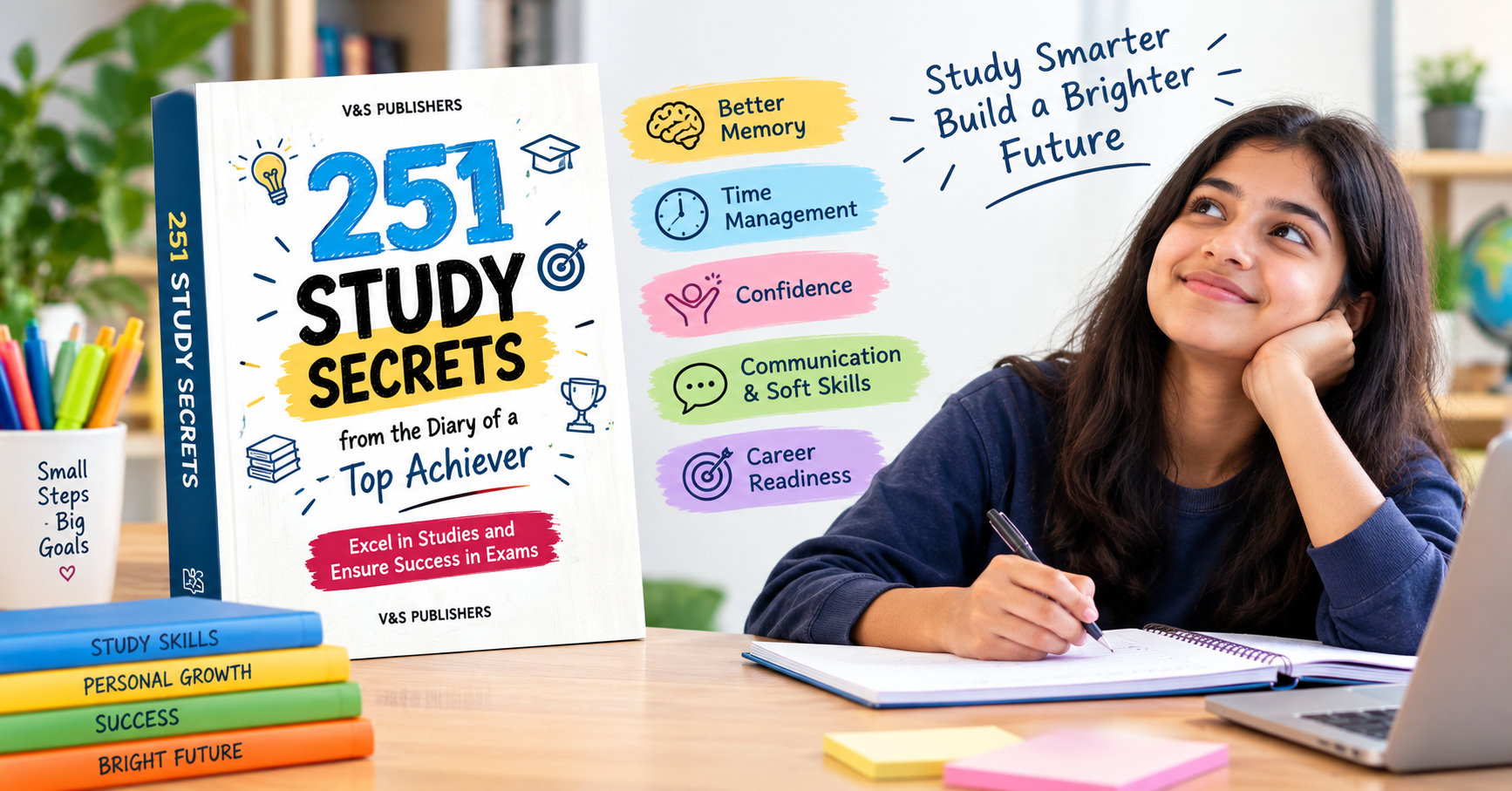
Most students are not short on effort. They are short on the right method. 251 Study Secrets from the Diary of a Top Achiever, published by V&S Publishers, is built around that exact idea: success in studies comes less from working harder in a general sense and more from using specific, tested techniques for confidence, memory, time management, and exam performance.
This guide walks through what the book actually covers, why its core techniques align with what cognitive science says about effective learning, and how personality development and soft skills fit into a student’s broader journey from school to career.
Along the way, we will look at real data on exam stress, memory retention, and workplace skill demand, since a student development book only earns its place on the shelf if it addresses problems that are genuinely widespread.
Why Study Skills and Soft Skills Matter More Than Grades Alone
Academic pressure in India is not a minor issue. A 2025 study across 1,628 students in eight major Indian cities found that nearly 70 percent experienced moderate to high anxiety during their preparation years.
A separate survey reported that 78 percent of undergraduates in an Indian sample experienced significant exam-related stress. Other research places the figure even higher among school-level students, with one review noting that more than 85 percent of Indian students experience moderate to severe exam stress at some point in their academic life.
Numbers this consistent across different age groups and study designs point to a genuine and widespread challenge rather than an isolated concern.
At the same time, the skills that matter once a student leaves school rarely show up on a mark sheet. Workplace research consistently ranks communication, problem-solving, and time management among the most valued soft skills.
One large-scale employee survey found that 84 percent of employees and managers consider soft skills necessary for new hires. That figure rises to 90 percent at large companies.
Student Stress and Soft Skills: Quick Data Snapshot
| Statistic | Figure | Source |
|---|---|---|
| Indian students with moderate to high exam anxiety | Approximately 70% | Multi-city Indian student survey |
| Indian undergraduates reporting significant exam stress | 78% | Indian undergraduate sample study |
| Indian students reporting moderate to severe exam stress | 85%+ | NIMHANS-backed research review |
| Employers who consider soft skills necessary for new hires | 84% | Workplace soft-skills survey |
| Same figure at companies with over 500 employees | 90% | Workplace soft-skills survey |
| Study secrets and techniques included in the book | 251 | V&S Publishers |
| Recommended age group | 9 to 18 years | V&S Publishers |
Inside 251 Study Secrets: What This Book Covers
The subtitle makes the book’s promise clear: Excel in Studies and Ensure Success in Exams. Rather than repeating a single method across several chapters, it is structured as a quick-help reference containing 251 short, concise tips.
The format is designed so students can read quickly, learn a technique, and put it into use immediately.
Book Snapshot
| Book Detail | Information |
|---|---|
| Book Title | 251 Study Secrets from the Diary of a Top Achiever |
| Subtitle | Excel in Studies and Ensure Success in Exams |
| Publisher | V&S Publishers |
| Category | Student Development, School Books |
| Age Group | 9 to 18 years |
| Language | English |
| Binding | Paperback |
| Colour | Black and White |
| Pages | 133 |
| Price | Rs. 250 (approx. USD 12) |
| Format | 251 short, concise, and immediately usable tips |
According to its description, the book addresses ten major topics that contribute to study success:
This range separates it from narrower how-to-study books. It treats academic performance as connected to mindset, health, and long-term goal setting rather than exam technique alone.
The Science Behind the Book’s Core Study Techniques
Several of the book’s techniques—particularly those covering concentration, memory, and exam preparation—align closely with established findings in cognitive and educational psychology.
Roediger and Karpicke’s 2006 research found that students who practised active recall by testing themselves retained approximately 80 percent of the material after one week. Students who only reread their notes retained approximately 34 percent.
A broader 2013 review of ten popular learning techniques by Dunlosky and colleagues rated practice testing as one of only two high-utility strategies worth prioritising. The other was spaced repetition, where review sessions are spread over increasing intervals instead of being compressed into one sitting.
These findings confirm that short, structured, repeated study sessions generally outperform long, unstructured cramming sessions for long-term retention.
What Cognitive Science Says About Common Study Methods
| Study Method | Retention Outcome |
|---|---|
| Active recall through self-testing | Approximately 80% retention after one week |
| Passive rereading of notes | Approximately 34% retention after one week |
| Spaced repetition | Consistently outperforms massed cramming for long-term memory |
| Practice testing | Rated a high-utility technique alongside spaced repetition |
| Concept mapping without active recall | Generally less effective than retrieval-based methods |
Beyond Study Skills: Personality Development and Soft Skills
251 Study Secrets does not stop at exam techniques. Its coverage of confidence, motivation, and communication positions personality development as a parallel goal alongside academic performance.
Employer surveys repeatedly rank problem-solving, communication, and time management among the most in-demand soft skills. One industry report identified time management as a top-three soft skill sought in new hires across multiple survey years.
Career readiness is built gradually. It does not suddenly begin when a student graduates. Habits involving goal setting, concentration, and confidence developed during school often carry directly into first job interviews and the transition from campus to the workplace.
Public speaking and presentation skills follow a similar development pattern. Students who practise structured communication through classroom presentations, group projects, and goal-setting conversations are better prepared for interviews and workplace communication later.
Confidence, Motivation, and Goal Setting
A recurring theme across the book’s ten core topics is the connection between mindset and performance. Confidence and motivation are treated as trainable abilities rather than fixed personality traits.
This aligns with how modern educational psychology approaches goal setting. Specific, written goals paired with a clear programme generally produce more consistent effort than vague intentions to “study harder.”
Positive thinking and structured routines also connect to student wellbeing. Given how widespread examination-related anxiety is, treating confidence building and stress reduction as study skills addresses a genuine need rather than adding a cosmetic motivational layer.
Age-Appropriate Growth: Why 9 to 18 Years Works
The 9 to 18 years age range deliberately covers a broad period of student development. Around age nine, students begin forming their first meaningful study habits and facing structured examinations.
By age 18, many students are preparing for board examinations, entrance tests, higher education, or early career decisions. These situations rely on the same underlying abilities—concentration, time management, motivation, and confidence— applied at higher stakes.
Because the book contains 251 short, independent tips rather than one linear course, younger readers can absorb a few habits at a time. Older students can search selectively for techniques relevant to specific challenges such as exam anxiety, concentration, or career choice.
How This Book Compares to Other Study Skills and Self-Help Titles
Many students already own either a subject-specific guide or a general motivational book. Here is how a tip-based student development title compares with a general self-help book.
| Feature | 251 Study Secrets | Typical General Self-Help Book |
|---|---|---|
| Core focus | Study skills and personality development | Broad life advice, often focused on adults |
| Format | 251 short, concise, immediately usable tips | Longer chapters and narrative case studies |
| Age relevance | Explicitly designed for ages 9 to 18 | Often written for adult professionals |
| Topics covered | Confidence, memory, time, career, and health | Varies widely by author |
| Reading style | Fast, quick-reference format | Usually intended for sequential reading |
| Price point | Rs. 250 (approx. USD 12) | Comparable or higher for similar page counts |
A Simple Way to Use This Book: Step-by-Step Reading Plan
- Skim the ten core topics first. Identify whether confidence, motivation, career planning, goals, brainpower, concentration, time management, health, or classroom learning is the most relevant area right now.
- Pick three tips to try this week. Trying too many techniques simultaneously makes it difficult to understand which ones are actually helping.
- Apply active recall to at least one subject. Pair the book’s memory advice with genuine self-testing rather than passive rereading.
- Space revision instead of cramming. Spread three or four topics across the week instead of reviewing everything during one long session.
- Track confidence and stress, not only marks. Record mood and stress alongside study output to determine whether a technique is genuinely sustainable.
- Revisit career and goal-setting sections periodically. These sections are especially useful during decisions about subjects, examinations, college, and career direction.
Who Should Read 251 Study Secrets?
Students Aged 9 to 15
Younger students benefit from concentration, memory, classroom learning, and time-management tips while their study habits are still developing.
Students Aged 15 to 18
Students preparing for board examinations or entrance tests benefit from the goal-setting, career, confidence, and exam-preparation sections.
Parents and Teachers
The ten-topic structure provides a quick reference for assigning relevant sections without requiring students to read the entire book at once.
College and Career Beginners
Communication, confidence, and career-planning advice can provide an early foundation for interviews and the transition from campus to the workplace.
About V&S Publishers
251 Study Secrets from the Diary of a Top Achiever is published by V&S Publishers , a Delhi-based educational publishing house active since the 1940s.
The publisher’s catalogue contains more than 2,000 titles across over 100 subjects, with student development and self-help forming established categories alongside Olympiad preparation and school reference titles.
Readers can browse the self-help and life skills collection for more books on personality development, motivation, and career readiness, or view the complete book catalogue .
Frequently Asked Questions
What topics does 251 Study Secrets cover?
It covers confidence, motivation, choosing a career, setting goals, increasing brainpower, success planning, concentration, time management, health, and classroom learning.
Is this book only about exam techniques?
No. It also covers confidence, motivation, career choice, health, and personality development, making it a combined study-skills and self-improvement guide.
What age group is this book designed for?
The book is designed for students aged 9 to 18 years.
Does the approach match research on effective studying?
Broadly, yes. Its focus on concentration, memory, and structured routines aligns with evidence supporting active recall and spaced repetition over passive rereading and last-minute cramming.
Can this book help with exam stress?
Indirectly, yes. It treats confidence and motivation as trainable skills and recognises the emotional side of examination preparation.
Is this book useful beyond school?
Yes. Its guidance on communication, career planning, confidence, and goal setting can support college applications, interviews, and early workplace development.
How is it different from an exam preparation guide?
Exam guides usually focus on subject content or question patterns. This book develops the habits, concentration, confidence, motivation, and time management that support performance across different subjects and exams.
Final Thoughts
251 Study Secrets from the Diary of a Top Achiever treats studying as a skill that can be trained—not a talent that some students simply possess and others do not.
Its 251 short, practical tips cover confidence, memory, time management, health, and career readiness. These themes align with effective learning research while also addressing the anxiety and stress many students experience during their examination years.
For students, parents, or teachers looking for a motivational self-help book that treats academic performance and personal growth as connected, this title provides a practical entry point designed specifically for ages 9 to 18.
Explore more titles on the V&S Publishers homepage .