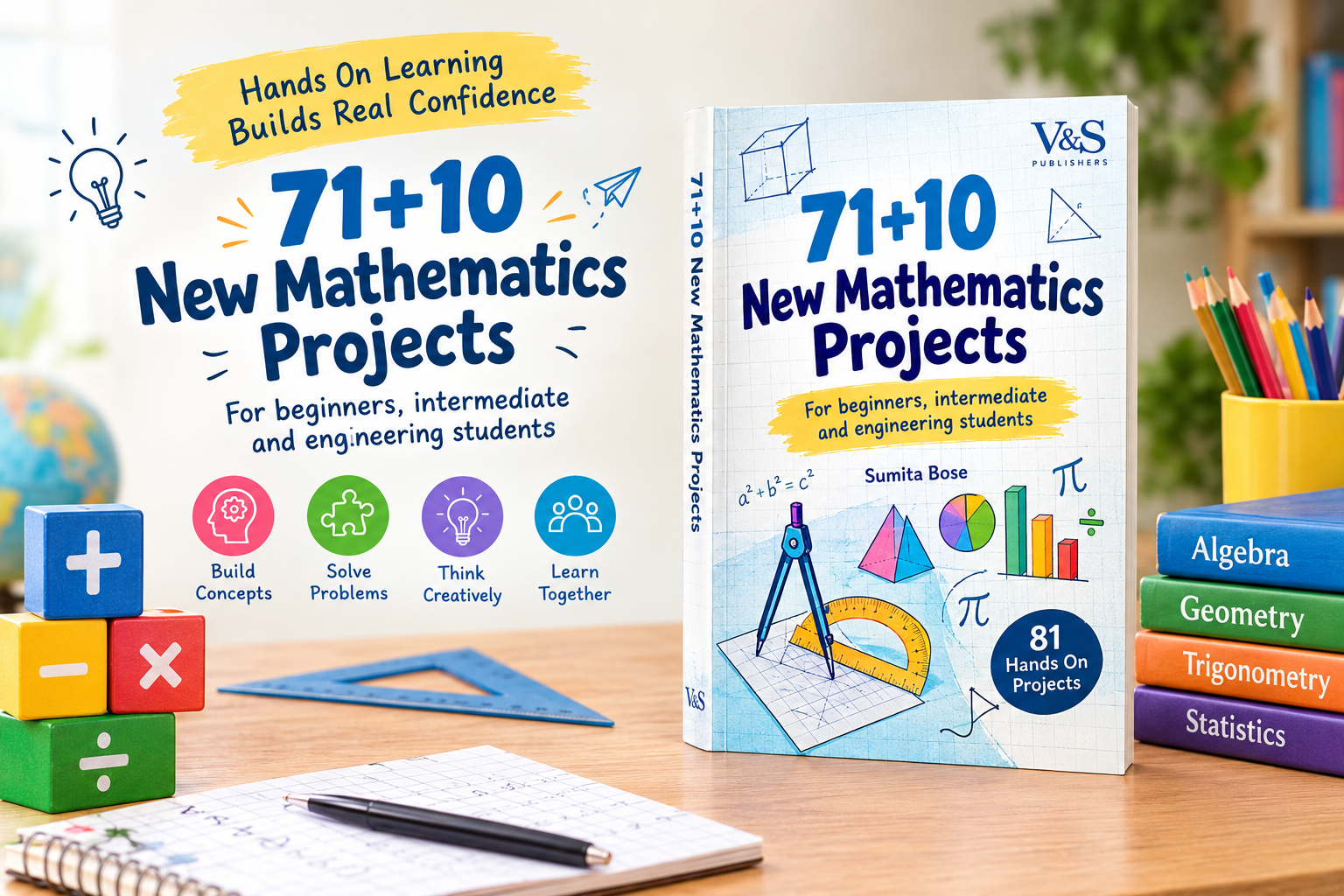
Learning mathematics through decision making, creativity and hands-on projects for students aged 9 to 18.
Ask most school students what subject worries them the most, and mathematics usually tops the list. It is not that the subject is harder than others on paper. It is that mathematics is often taught as a set of formulas to memorise rather than a set of ideas to explore.
That shift from memorising to building is exactly what 71+10 New Mathematics Projects, published by V&S Publishers, sets out to achieve.
This is not a textbook or a workbook of extra sums. It is a mathematics activity book for children and teenagers that turns 81 classroom-tested projects into a structured, step-by-step programme for concept development.
This guide examines what is inside the book, why project-based learning works so well for reducing maths phobia, and how the title fits into the wider world of school project books and STEM activities for students.
Why Mathematics Phobia Is a Real, Documented Problem
Maths anxiety is not simply a phrase parents and teachers use loosely. It is a well-studied psychological response, and research findings remain consistent across countries.
A study published in NCERT's journal, The Primary Teacher examined mathematics anxiety among upper-primary students in Andhra Pradesh. It confirmed that everyday classroom experiences directly influence how anxious a child feels about mathematics over time.
A 2024 study on students' self-perception of mathematics anxiety found that 60 percent of students recognised experiencing mathematics anxiety. That figure increased to 86.67 percent after an educational intervention helped them reflect on it.
The same research found that anxiety peaked during high school for 48 percent of students. It also found that 68 percent believed they could manage the anxiety once they understood that it was temporary.
Earlier research on mathematics anxiety found that affected students were often normal to high achievers rather than poor performers. Confidence-building resources can therefore benefit students across different performance levels.
Quick Data Snapshot
| Statistic | Figure | Source |
|---|---|---|
| Students self-reporting maths anxiety after reflection | 86.67% | Academic Journal of Mathematics Education, 2024 |
| Students who believed they could manage maths anxiety | 68% | Academic Journal of Mathematics Education, 2024 |
| Students reporting anxiety peaking during high school | 48% | Academic Journal of Mathematics Education, 2024 |
| Score improvement in ratio, proportion and percentage through project-based learning | Statistically significant improvement | European Journal of Science and Mathematics Education |
| Total projects in 71+10 New Mathematics Projects | 81 | V&S Publishers |
| Recommended age group | 9 to 18 years | V&S Publishers |
Inside 71+10 New Mathematics Projects
The book's full promise sits in its subtitle, “For beginners, intermediate and engineering students.” This signals that it is designed to grow with the learner rather than being aimed at one grade level.
Instead of long chapters of theory followed by practice sums, the book is organised as a project-based resource in which mathematical ideas are paired with activities that students complete individually or with a partner.
Book Snapshot
| Book Title | 71+10 New Mathematics Projects |
| Subtitle | For beginners, intermediate and engineering students |
| Author | Sumita Bose |
| Publisher | V&S Publishers |
| Category | Student Development, School Books |
| Age Group | 9 to 18 years |
| Language | English |
| Binding | Paperback |
| Colour | Black and White |
| Pages | 248 |
| Price | Rs. 295 (approximately USD 12) |
| Extras | Supplementary online content available through Dropbox |
The book is written by Sumita Bose, a veteran school teacher with classroom experience across reputed Delhi schools. This helps explain why the activities feel suitable for real classroom use.
It also belongs to V&S Publishers' long-running 71 Series, which includes titles such as 71 Science Experiments and 71 Arts and Crafts for School Children.
Readers can browse similar titles through the school and exam-preparation categories and the children's activity books collection .
What the 81 Projects Cover
Rather than focusing on one narrow topic, the 81 projects reinforce concepts across school mathematics. They are aligned with the CCE curriculum framework followed by CBSE and other State Boards.
Concept and Decision-Making Projects
Students apply mathematical ideas to solve self-contained problems, encouraging systematic reasoning instead of rote calculation.
Skill-Building and Creative Projects
Activities use paper folding, measuring and simple constructions to make geometry, mensuration and number concepts easier to visualise.
Individual and Partner Projects
The book combines independent work with two-student activities that encourage cooperative learning and shared problem solving.
Reinforcement Projects
Later activities revisit earlier concepts in new contexts, helping students consolidate their understanding before moving ahead.
The Research Behind Project-Based Mathematics Learning
The case for activity-based learning is supported by educational research. A study on project-based learning and primary-school mathematics outcomes found a statistically significant improvement between pre-test and post-test scores after the approach was introduced.
A classroom study on ratio, proportion and percentage reported an average score of 84.72 for the project-based class compared with 65.53 for the class taught through conventional lecture methods.
A broader review of project-based mathematics learning found that this approach can develop problem-solving, collaborative learning, creative thinking, communication and student confidence.
Why the 9 to 18 Age Range Works
The age range is wider than most activity books attempt. It works because the projects can be selected according to the student's current learning level instead of being completed strictly from the first page to the last.
Ages 9 to 12
Visual and practical projects provide a gentle bridge from arithmetic towards geometry, measurement and structured mathematical reasoning.
Ages 13 to 15
Students connect number work, geometry and basic statistics with real-world decision making and creative problem solving.
Ages 16 to 18
Older students and engineering aspirants can revisit important fundamentals through an applied approach before specialising further.
How the Book Supports School Projects and CBSE Learning
The activities use easy-to-source materials and instructions that students can largely follow independently. This makes the book useful in several common learning situations:
- School mathematics fairs and exhibitions with one- or two-week deadlines
- Weekend and holiday enrichment activities
- Classroom demonstrations assigned as individual or partner work
- Home-based revision in a format different from a textbook
- Preparation for students who also use Olympiad-level mathematics guides
Because the activities are based on the CCE curriculum followed by CBSE and other State Boards, teachers can use them alongside regular syllabus topics with limited additional adaptation.
Comparison With Typical Activity Books
Parents and teachers often compare mathematics project books by the number of activities, curriculum relevance, age range and learning format.
| Feature | 71+10 New Mathematics Projects | Typical Activity Book |
|---|---|---|
| Number of projects | 81 | 20 to 40 |
| Age range | 9 to 18 years | Usually a narrow two- to three-year range |
| Curriculum alignment | CCE curriculum, CBSE and State Boards | Often generic and not curriculum mapped |
| Format | Individual and partner projects | Usually individual activities only |
| Bonus content | Online content through Dropbox | Rarely included |
| Focus | Decision making, creativity and concept reinforcement | Often drill-based practice sums |
| Price point | Rs. 295 (approximately USD 12) | Comparable or higher |
| Author background | Written by an experienced school teacher | Varies widely |
Students interested in the same hands-on approach to science can also explore 101+10 New Science Games or 71 Electrical and Electronic Projects .
How to Use This Book at Home
- Identify the current classroom topic. Match the child's school syllabus with a relevant project instead of working through the book strictly in page order.
- Read the project brief together. Discuss the mathematical concept the activity is intended to reinforce.
- Gather the materials in advance. Most projects use items already found at home or in a school supply cupboard.
- Begin with an individual project. Independent work can help students build confidence before collaborating.
- Move to a partner project. Pair the student with a sibling, parent or classmate to develop cooperative reasoning.
- Revisit a reinforcement project. Return to an earlier concept after a few weeks to confirm that the learning has been retained.
Who Should Buy This Book?
About V&S Publishers
71+10 New Mathematics Projects is published by V&S Publishers , a Delhi-based educational publishing house active since the 1940s.
Its catalogue spans more than 2,000 titles across over 100 subjects and nine languages. The publisher has a long history of producing activity-based learning books for school students, including the wider 71 Series.
The publishing house has received recognition at industry events, including a Federation of Indian Publishers award for excellence in book production. It also continues to expand its catalogue through digital and audiobook formats.
Frequently Asked Questions
What age group is this book suitable for?
The book is designed for students aged 9 to 18 years, including beginners, intermediate learners and students preparing for engineering-level study.
How many projects are included in the book?
The book contains 81 classroom-tested mathematics projects, matching the 71+10 in its title.
Is the book aligned with the CBSE syllabus?
Yes. The projects are based on the CCE curriculum followed by CBSE and other State Boards.
Does the book require expensive equipment or lab access?
No. The projects use materials that are easily available at home or in a basic school supply cupboard.
Who wrote 71+10 New Mathematics Projects?
The book is written by Sumita Bose, an experienced school teacher who has taught in reputed Delhi schools.
Is digital or online content included?
Yes. Supplementary online content is available through Dropbox alongside the printed book.
Can this book help with maths phobia?
The step-by-step, hands-on structure is designed to build student confidence and reduce anxiety commonly associated with mathematics.
Are the projects for individual or group work?
Both. The book contains a mixture of individual projects and partner projects that encourage cooperative learning.
Who publishes this book?
The book is published by V&S Publishers, a New Delhi-based educational publisher active since the 1940s.
Final Thoughts
Mathematics anxiety is well documented, but research also shows that it can respond to the right teaching approach. 71+10 New Mathematics Projects gives students a structured, curriculum-aligned way to build confidence through 81 hands-on activities instead of repeated drill practice.
For parents and teachers looking for school books that make mathematics feel approachable rather than intimidating, this title combines an experienced teacher's classroom insight with more than eight decades of educational publishing experience.