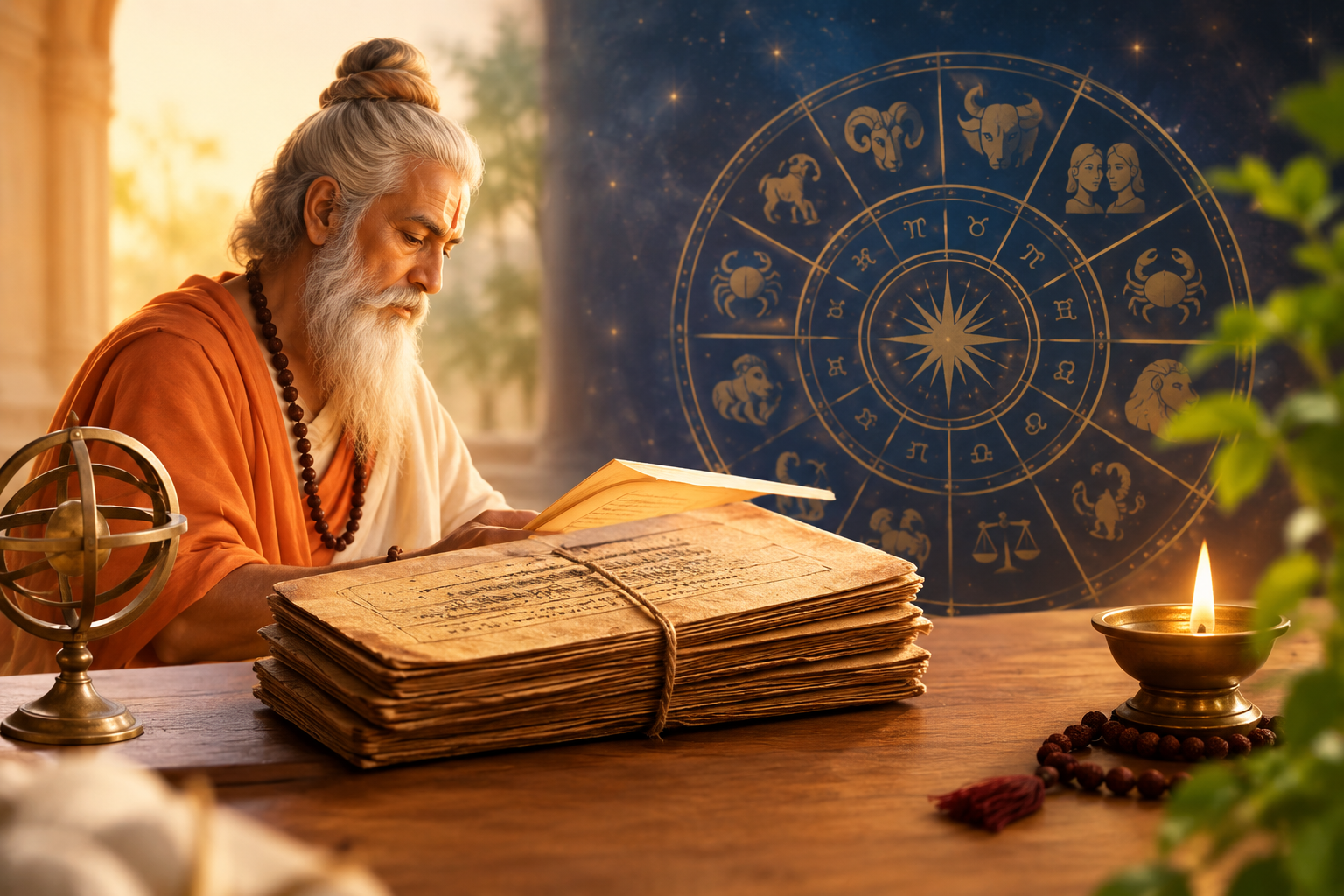
A simple introduction to Bhrigu Sanghita, its traditional roots, and how it brings astrology and palmistry together.
If you have heard people talk about a "birth chart that was written for you thousands of years ago," they are most likely talking about Bhrigu Sanghita. It is one of the oldest and most talked about books in Indian astrology. This guide explains what the book is, where it comes from, what it contains, and how it connects astrology with palmistry, in simple words that anyone can follow.
Quick Answer
Bhrigu Sanghita is an ancient Sanskrit astrology text linked to the sage Bhrigu, one of the seven great sages in Hindu tradition. It is believed to contain horoscope predictions written thousands of years ago, based on a person's date, time, and place of birth. The book covers birth chart basics, planetary combinations called Phaladesha, and planetary periods called Mahadasha. Today, simplified printed editions, like the one from V&S Publishers, make this old system easy for beginners to read and understand.
What Is Bhrigu Sanghita?
Bhrigu Sanghita (also spelled Bhrigu Samhita) is a Sanskrit text on Jyotish, the Indian system of astrology. According to Wikipedia's entry on the subject, the text is attributed in its own introduction to the sage Bhrigu, one of the Saptarishis, or seven great sages, of the Vedic period, and its opening chapter says it was compiled so that people could better handle the difficulties of life and grow spiritually.
In simple terms, the book claims to hold horoscope readings for a huge number of people, written down long before those people were even born. An astrologer who works with this system tries to match your date and time of birth with one of these old records to give you a personal reading.
It is important to be clear about one thing early on. Much of what is said about Bhrigu Sanghita comes from tradition and belief, passed down by word of mouth and by families of astrologers. There is no independent historical record that proves the exact date it was written or confirms every claim made about it. A good beginner's guide should say this openly, instead of presenting old legends as proven facts.
Who Was Sage Bhrigu?
Sage Bhrigu holds an important place in Hindu tradition. He is counted among the Saptarishis, the seven sages said to have deep spiritual knowledge. Different traditions describe him in different ways.
- In one account shared by Isha Foundation founder Sadhguru, Bhrigu was one of the first seven disciples of Shiva, known for his intense devotion.
- Book listings such as the one on ExoticIndia describe him as the first compiler of predictive astrology, said to have recorded a huge number of horoscopes with the help of Lord Ganesha, and note that this work is sometimes linked to what later became the Brihat Parashara Hora Shastra, an important classical text on astrology.
- Bhrigu is also said to have taught this art of prediction to his son Shukra and to other students.
These accounts come from religious and traditional sources, not from modern historical research, so they should be read as part of the cultural and spiritual story around the text, not as verified history.
The History and Origin of Bhrigu Sanghita
Vedic Roots
Bhrigu Sanghita is generally placed within the wider family of Jyotish texts, a field of study that stretches back thousands of years in India. Most sources describe the book as very old, often saying it goes back "thousands of years," but you will notice that almost no source gives an exact, verifiable year. This is common with many ancient Sanskrit texts, since they were written and copied long before anyone kept publication records the way we do today.
How the Text Survived Through the Ages
The original material is said to have been written on palm leaves, which was the common way of keeping written records in old India. Palm leaves are fragile. Heat, insects, and simple wear and tear destroy them over time. Because of this, large parts of the original material are believed to be lost.
According to Wikipedia, parts of the surviving material are said to be kept today in the Hoshiarpur district of Punjab and in the Varanasi district of Uttar Pradesh. A related academic style document on Nadi astrology notes that the Tamil style of Nadi readings, connected to leaves said to be written by the sage Agathiyar, follows a different style from Bhrigu Sanghita, which is more common in North India and has been published only in part, with the document also warning that many spurious versions exist in the market under the Bhrigu name.
This point matters for anyone buying a book on this subject. Since the original palm leaf collection was never fully published as one single, verified text, printed books that use the name "Bhrigu Sanghita" are best understood as compilations and explanations built around this tradition, written to help ordinary readers understand the system, rather than word for word copies of a lost original manuscript.
What Does the Book Usually Contain?
Most printed editions of Bhrigu Sanghita, including simplified Hindi language versions meant for general readers, are organised into a few broad parts. Based on how such editions are commonly structured, here is a simple breakdown:
| Section | What It Covers | Who It Helps |
|---|---|---|
| Basic birth details (Janam Kundali) | How to read a birth chart, houses, signs, and planets | Complete beginners |
| Phaladesha (planetary combinations) | What it means when planets sit together, in opposite signs, or in triangle positions, and how friendly or unfriendly signs affect results | Readers who already know the basics |
| Mahadasha (planetary periods) | The order and length of major planetary periods and what each period tends to bring | Readers who want deeper, long term predictions |
This structure matches the general shape described in the book description for this title, which talks about basic information in the early part, planetary combination topics such as high, low, own sign, triangle, friendly, and enemy positions in the middle part, and planetary period, or Mahadasha, topics in the final part.
Common Topics Inside
A typical beginner edition will usually walk through:
- How to set up and read a basic birth chart
- The meaning of the 12 houses and how they connect to different life areas such as health, marriage, career, and family
- How planets behave when they sit in different signs
- Basic remedies, often related to gemstones, colours, or simple rituals, suggested when a planet is considered weak or troublesome
- An introduction to Mahadasha, the planetary period system used for timing events
Is Bhrigu Sanghita the Same as Nadi Astrology?
This is one of the most common questions beginners ask, so it deserves a clear answer.
Bhrigu Sanghita and Nadi astrology are related but not identical. Nadi astrology is a broader term for palm leaf prediction systems found across India. The Tamil Nadu style, linked to leaves said to be written by the sage Agathiyar and once stored at the Saraswati Mahal Library in Thanjavur, is one branch. Bhrigu Sanghita is described as the North Indian parallel to this Tamil tradition, following its own separate style. So you can think of Nadi astrology as the wider family and Bhrigu Sanghita as one well known branch within that family, mainly linked to North India.
Palmistry and Bhrigu Sanghita: How They Come Together
The subtitle of this book, "Astrology and palmistry come together to predict future," points to something worth explaining. Traditional Indian prediction systems rarely treated astrology and palmistry as two separate, unrelated subjects. Both were seen as different tools for reading the same thing: a person's life pattern.
- Astrology looks at the sky at the moment of birth, the positions of the Sun, Moon, and planets, to build a chart.
- Palmistry looks at the lines, mounts, and shape of a person's palm to read personality traits and possible life events.
A book that combines both gives beginners a wider toolkit. You are not limited to only birth chart reading. You can also learn to look at basic palm features such as the life line, heart line, and head line, and see how these ideas are traditionally believed to support or confirm what the birth chart shows.
Does Bhrigu Sanghita Really Predict the Future? Different Views
This is a fair question, and a good guide should present more than one side.
The traditional and spiritual view: Supporters see Bhrigu Sanghita as a form of guidance rooted in karma. A quote attributed to Maharishi Bhrigu, carried by Times of India, describes the horoscope as a map of a person's past karma, reflecting the belief that a birth chart shows patterns already set in motion by earlier actions, not a fixed, unchangeable fate. In this view, astrology and palmistry are tools for self understanding, not tools that remove free will.
The cautious and critical view: Many educated readers, researchers, and even some astrology critics point out real problems. There is no single verified original manuscript. Many people across India claim to hold the "real" Bhrigu leaves, which cannot all be true at once. Predictions are often written in a general way that can fit many different people and situations, a pattern that psychologists sometimes call the Barnum effect, where vague statements feel personally accurate to almost anyone who reads them.
A sensible, honest way to read this book is as a window into a rich cultural and philosophical tradition, useful for understanding how Indian society has thought about fate, character, and timing for centuries, while treating specific predictions with a healthy amount of personal judgement rather than blind certainty.
Who Should Read This Book?
This particular Hindi language edition from V&S Publishers is written for general readers, not only trained astrologers. Based on the book's own description, it is meant to be useful even for readers who are new to astrology or who have limited formal education, since it explains ideas in plain language rather than heavy technical Sanskrit terms.
It suits:
- Beginners who want a first, simple introduction to Vedic astrology and palmistry
- Readers aged 18 to 60 who are curious about horoscope reading, remedies, and basic prediction methods
- Hindi readers who want a home reference book rather than a paid consultation
- Students of astrology who want a starting text before moving to more advanced classical works
- Anyone interested in Indian spiritual and occult traditions as a subject of study, not only as a personal belief system
Book Details at a Glance
| Detail | Information |
|---|---|
| Book name | Bhrigu Sanghita |
| Publisher | V&S Publishers |
| Language | Hindi |
| Binding | Hardback |
| Pages | 800 |
| Black and white | |
| Price | Rs 495 (about USD 25) |
| Category | Religion and Spirituality, Astrology and Palmistry |
| Suggested age group | 18 to 60 years |
An 800 page hardback is meant to be a long term reference book, something you keep on a shelf and return to again and again, rather than a quick, one time read.
How to Start Reading Bhrigu Sanghita: Tips for Beginners
Reading a text this large can feel heavy at first. These simple steps make it easier:
- Start with your own birth chart. Before reading planetary combinations, get your correct date, time, and place of birth ready, since almost every explanation in the book will ask you to apply it to a real chart.
- Learn the 12 houses first. Understanding what each house represents (self, wealth, siblings, home, children, health, and so on) makes every later chapter easier to follow.
- Move to Phaladesha slowly. Do not try to memorise every planetary combination at once. Read one planet at a time and note down what it means in your own chart.
- Save Mahadasha for later. Planetary period reading builds on everything before it, so it works best as a final step, not a starting point.
- Cross check with a second source. Since a single book cannot cover every classical rule, pairing it with a basic Vedic astrology reference or a trusted class can help clear up confusing points.
Bhrigu Sanghita FAQs
Is Bhrigu Sanghita the same as a horoscope?
Not exactly. A horoscope is your personal birth chart. Bhrigu Sanghita is a text that explains how to read and interpret such charts, along with, according to tradition, a set of old horoscope records tied to the sage Bhrigu.
Can a complete beginner understand this book?
Yes. This edition is written for general readers in simple Hindi, not for trained astrologers only, so it works well as a first book on the subject.
Is this book only about astrology?
No. The subtitle makes it clear that astrology and palmistry are covered together, so readers also get an introduction to basic palm reading.
Does Bhrigu Sanghita include remedies?
Traditional editions usually include basic remedies, such as gemstone or colour suggestions, connected to weak or troublesome planets in a chart.
Is Bhrigu Sanghita scientifically proven?
No formal scientific proof supports astrological prediction, including this text. It should be approached as a cultural, spiritual, and philosophical tradition rather than a proven predictive science.
Where are the original Bhrigu leaves kept today?
Tradition places surviving portions in the Hoshiarpur district of Punjab and the Varanasi district of Uttar Pradesh, though no single, complete, verified original manuscript is publicly confirmed to exist.
Final Thoughts
Bhrigu Sanghita sits at the meeting point of history, belief, and everyday curiosity about the future. Whether you read it as a spiritual guide, a cultural artefact, or simply an interesting old system worth understanding, this 800 page Hindi edition gives beginners an accessible way in, without needing years of Sanskrit study first. Read it with curiosity, keep your judgement switched on, and treat it as one voice in India's long conversation about fate, character, and time.
If this introduction has sparked your interest, you can browse more titles on astrology, palmistry, and Indian spiritual traditions in our Religious and Spiritual books collection, or head to our blog for more beginner guides like this one.