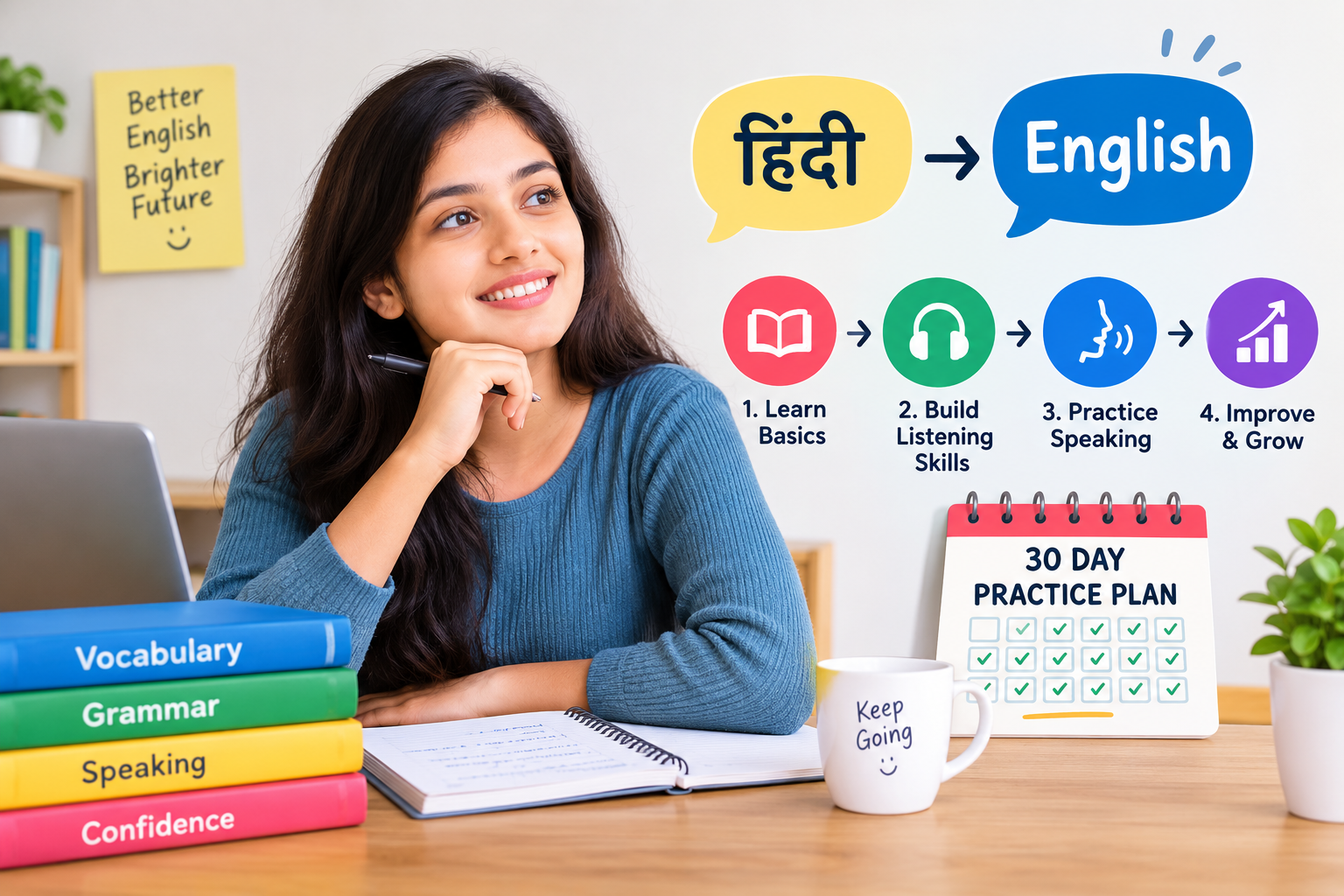
If you want to know how to speak English fluently from Hindi, the answer is practice that starts with sounds and ends with real conversations. The Excel English Speaking Course by V&S Publishers follows that path in 584 pages written in Hindi, moving from the alphabet and pronunciation to grammar, sentences, conversation, writing and vocabulary. This guide turns that path into a clear method, a 30-day practice plan and fixes for the mistakes that hold most beginners back.
Quick answer: Learn the sounds first, build simple sentences, speak aloud every day and review on a schedule. A sensible first goal is level B1 on the CEFR scale. A structured Hindi course gives you one sequence to follow, and the plan below builds the habit.
Key Takeaways
- Begin with sounds and pronunciation, because English spelling does not show you how a word is spoken.
- Learn only the grammar you need to build sentences, then practise those sentences aloud.
- Use full conversations, not isolated words, so your mouth learns complete patterns.
- Review on a spaced schedule instead of cramming, so what you learn stays with you.
- Pair one structured book with trusted free audio, and record yourself often.
Can You Learn English Speaking Through Hindi?
Yes, and learning through your own language is nothing to apologise for. A Hindi explanation lets you grasp a rule in one reading, so your energy goes into speaking instead of decoding instructions. The 2011 Census of India recorded about 129 million people, roughly 10.6 percent of the population, who spoke English as a first, second or third language; only 259,678 named it as their first language. Almost everyone you hear speaking English around you learned it later in life.
Hindi also gives you something useful to compare against. A Hindi sentence normally places the verb at the end, as in “मैं रोज़ चाय पीता हूँ”. English places the verb straight after the subject: “I drink tea every day.” Noticing that difference explains many word-order mistakes.
What Does Fluent Actually Mean?
The Council of Europe describes six language levels from A1 to C2. At B1, a learner can follow the main points of clear, standard speech on familiar matters at work, school or leisure. For a Hindi-speaking beginner, B1 is a realistic first destination. Thirty days will not make anyone a native speaker; they build the base of sounds, sentences and speaking habit that B1 depends on. Read the Council of Europe level descriptions.
The Five Stage Method
Start with the alphabet and pronunciation. Hindi spelling is a reliable guide to sound, but English spelling is not, so learn the sounds themselves.
Study pronouns, the verb “to be”, present tense, simple questions, then past and future—only what you need to build a sentence.
Use ready-made sentences for greeting, asking, requesting and refusing rather than building every sentence from scratch.
Join sentences into dialogues. The course includes 50 conversations in Hindi and English.
Use letters, translation, email, WhatsApp messages, topic word lists and exercises with answers to check progress.
Your 30 Day English Speaking Practice Plan
Each day takes about 50 minutes: 10 minutes listening and repeating, 15 minutes studying, 10 minutes speaking without looking, 10 minutes writing or recording, and 5 minutes reviewing yesterday's notes. If you only have 30 minutes, keep the speaking and review blocks and shorten the rest.
Learn letter names and sounds; English has 26 letters but around 44 sounds. Work through vowels and consonants, record ten words, then learn greetings and a short self-introduction.
Practise pronouns, am/is/are and the present simple; then what, where, when, why and how questions; then past and future simple with a revision test.
Choose one dialogue every two days. Read Hindi then English, listen and repeat; act out both roles without the book and change details to fit your life. Finish with a one-minute talk about your day.
Practise emails and WhatsApp messages, learn ten new words a day and use each in a sentence. Record a three-minute talk on Day 30, compare it with Day 1 and carry errors into month two.
Review new material the next day, again after three days and again after a week. This spaced repetition slows the forgetting curve. After Day 30, repeat the cycle with new topics, using BBC Learning English and British Council LearnEnglish, and find one person to speak with each week.
Pronunciation Fixes for Hindi Speakers
- V and W: For V, let upper teeth touch the lower lip. For W, round the lips and keep teeth away.
- The TH sounds: Put the tip of your tongue lightly between your teeth and push air out for “think”. Add voice for “this”.
- Stress and rhythm: Stress important words and let small words shrink: “I want to GO to the MARket.”
- Spelling traps: Do not pronounce every letter. The l in “salmon” is not pronounced in standard speech.
Use the EnglishClub phonemic chart for a visual guide to the 44 sounds.
Everyday Conversation: Five Lines to Practise Today
- “क्या आप मेरी मदद कर सकते हैं?” — “Can you help me?”
- “मैं अपना परिचय देना चाहता हूँ।” — “I would like to introduce myself.”
- “कृपया थोड़ा धीरे बोलिए।” — “Please speak a little slowly.”
- “मुझे थोड़ा समय चाहिए।” — “I need a little time.”
- “मैं कल दफ्तर नहीं आ पाऊँगा।” — “I will not be able to come to the office tomorrow.”
Use shadowing: play a short audio clip and repeat each sentence after the speaker, copying rhythm as well as words. Then replay the dialogue from memory, changing one detail each time.
Writing Emails and WhatsApp Messages
Keep messages short, put the request in the first line and close politely.
Subject: Request for leave on Friday
Dear Sir, I would like to request leave on Friday because of a family function. I will complete my pending work before I leave. Kindly approve my request. Thank you, Rahul
A casual message can be: “Hi Priya, I will reach by 6. Please wait for me at the gate.”
Habits That Slow Learners Down
- Translating word by word. Learn whole sentences and conversation patterns instead.
- Waiting until you are perfect. Speak now, then correct it.
- Reading without speaking. Always say the example aloud.
- Skipping review. Keep a notebook of errors and revisit it on schedule.
- Quitting after a bad week. Progress is uneven; return to the routine.
Inside the Excel English Speaking Course
| Book Detail | Information |
|---|---|
| Title | Excel English Speaking Course (With Youtube AV) |
| Subtitle | How to Speak English Correctly at All Places |
| Author | Sahil Gupta |
| Publisher | V&S Publishers |
| Language | Hindi |
| Format | Paperback, 584 pages |
| ISBN | 9789357941303 |
| MRP | ₹295 in India, US$12 internationally |
| Suggested age group | 14 to 25 years |
The book has eight sections: Alphabet, Pronunciation, Grammar, Sentences, Conversation, Writing, Vocabulary and Exercises. It includes correct pronunciation, word and sentence formation, simple grammar, sentences for every situation, 50 bilingual conversations, letters and translation, email and WhatsApp, classified Hindi-English vocabulary, and self-testing exercises with answers. A book cannot replace speaking with another person, so schedule regular conversations with a friend, family member or study partner.
Where to Buy the Book
The course is listed on Amazon.in and Flipkart. V&S books also reach readers through bookstores, school networks and online retailers, as described on the Distribution page. Marketplace prices can differ from printed MRP, so check the current price before ordering.
Frequently Asked Questions
Can I learn to speak English fluently from Hindi at home?
Yes. A structured Hindi-medium course, daily speaking practice and regular review build a strong foundation. Speak aloud and record yourself, not just read.
How long does it take to speak English fluently?
Thirty days build sounds, basic sentences and a daily habit. Comfortable familiar-topic conversations around B1 usually take several months of regular practice.
Is the Excel English Speaking Course suitable for beginners?
Yes. It begins with alphabet and pronunciation, then grammar, sentences, conversation, writing and vocabulary, with exercises and answers.
How many sounds does English have?
English has 26 letters but about 44 sounds in standard British pronunciation. The exact count varies slightly by accent.
What should I look for in an English speaking book in Hindi?
Look for a clear sequence from sounds to sentences to conversation, Hindi explanations, exercises with answers, and audio or video support.
Can I improve pronunciation without a teacher?
Yes, to a large extent. Use a phonemic chart, record yourself, compare with trusted audio, and practise V/W and TH sounds daily. A teacher or partner can still provide useful feedback.
Conclusion
Learning to speak English fluently from Hindi is a sequence of small, repeatable steps: sounds, sentences, conversations, writing and review. Follow the 30-day plan, record yourself, and keep one structured book as your guide. When you are ready for more reading on learning, books and study skills, visit the V&S Publishers blog. Individual results vary, and this guide is for general educational purposes.