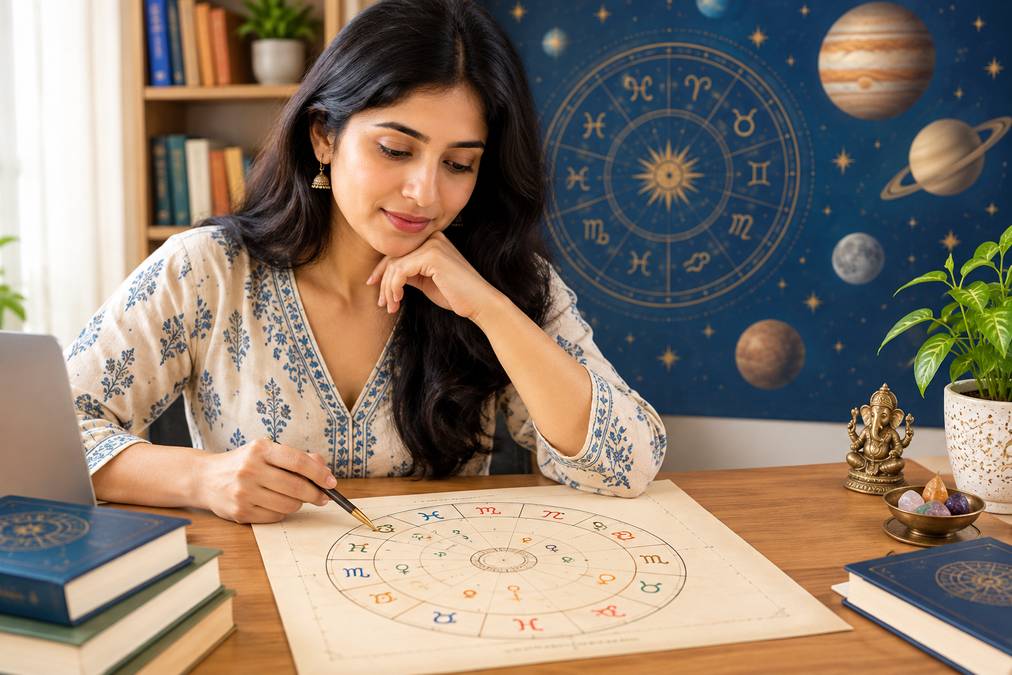
A beginner-friendly guide to understanding the signs, houses, planets and timelines inside a Vedic birth chart.
Open any Vedic birth chart for the first time and it can look like a maze: a square or diamond grid, unfamiliar Sanskrit words, and planet abbreviations in boxes that mean nothing to an untrained eye.
Yet every box answers a specific question about a person's life, personality, relationships, career or health. Once you know what each part of the chart is built from, reading it becomes a form of pattern recognition.
This guide walks through the core building blocks of a Vedic birth chart, called a Janam Kundali: the zodiac signs, planets, houses, planetary periods and combinations that shape an interpretation. By the end, you should be able to understand the broad story a basic chart is telling, before consulting a professional astrologer for a full reading.
What Is a Vedic Birth Chart, and Why Does It Matter?
A birth chart, or Kundali, is a snapshot of the sky at the exact moment and place a person was born. Vedic astrology, also called Jyotish, maps where the Sun, Moon and other planets sat against the zodiac at that instant, then reads meaning into those positions.
One important point separates Vedic astrology from the Western astrology often seen in newspaper horoscopes. Vedic astrology uses the sidereal zodiac, aligned with the currently observed positions of the constellations. Western astrology uses the tropical zodiac, which is fixed to the seasons rather than the stars. Over centuries, the difference between the two systems has grown to roughly 24 degrees, which is why the same birth details can sometimes produce a different sun sign.
The Building Blocks: Rasis, Grahas, and Nakshatras
Before a chart can be read, it helps to know the three sets of symbols that fill it.
The 12 Rasis
These are the twelve zodiac signs, Aries through Pisces, calculated on the sidereal zodiac. Each Rasi has traditional qualities, and together they form the basic vocabulary every other layer of the chart builds on.
The 9 Grahas
The Navagraha includes the Sun, Moon, Mars, Mercury, Jupiter, Venus and Saturn, along with Rahu and Ketu—the Moon's north and south lunar nodes. Each Graha represents different themes in life.
The 27 Nakshatras
These lunar mansions divide the zodiac into finer sections of 13 degrees and 20 minutes each. The Nakshatra containing the Moon at birth is especially important for calculating planetary periods.
How They Work Together
A complete interpretation does not rely on one sign or planet alone. It considers the sign, house, planet and their relationship to the rest of the chart together.
What You Need Before You Can Cast a Chart
Casting an accurate Vedic chart requires three details: the exact birth date, exact birth time and precise birth place. Birth time is particularly important because even a difference of a few minutes can shift the Ascendant and change the house positions that follow.
Why Birth Time Matters
If the exact birth time is unknown or uncertain, some astrologers use birth-time rectification. They work backward from confirmed major life events to narrow down the likely time of birth.
Finding the Lagna: The Starting Point of Every Chart
The Lagna, or Ascendant, is the zodiac sign rising on the eastern horizon at the precise moment of birth. It becomes the first house of the chart and acts as its anchor point. Because the Earth completes a rotation in 24 hours and there are 12 Rasis, the Lagna shifts to the next sign roughly every two hours.
Most Vedic charts use the Whole Sign house system. The Rasi containing the Lagna becomes the whole first house, the next Rasi becomes the second house, and so on around the chart. This differs from Western systems such as Placidus, where houses can span unequal arcs of the sky.
Making Sense of the Twelve Bhavas (Houses)
Once the Lagna is fixed, the chart divides into 12 Bhavas, or houses. Each governs a particular area of life. The first house relates to self, personality and appearance; the second to wealth, speech and family; the seventh to partnerships and marriage; and the tenth to career and public standing.
| House Group | Houses | Traditional Focus |
|---|---|---|
| Kendra | 1, 4, 7 and 10 | Pillars of strength and stability |
| Trikona | 1, 5 and 9 | Fortune and blessings |
| Dusthana | 6, 8 and 12 | Challenges, obstacles and transformation |
| Upachaya | 3, 6, 10 and 11 | Areas believed to improve with age and effort |
| Maraka | 2 and 7 | Traditionally connected with health-related turning points |
As a general rule, a house holding more planets tends to carry more weight in a person's life story. Whether that influence is supportive or challenging depends on the planets involved and how they are positioned.
Reading the Planets Within the Houses
A planet's meaning changes with the house it occupies. Jupiter in the tenth house may favour career growth and public recognition, blending themes of wisdom and expansion with profession and status. Jupiter in the twelfth house produces a different influence, possibly pointing towards foreign travel, spiritual retreat or study abroad.
This is why a beginner should never read a single planet or house in isolation. Chart interpretation is layered: the sign, house and planet's relationship with other planets are all considered together.
Understanding Mahadasha: The Planetary Timeline of a Life
A birth chart shows a person's potential, but it does not by itself say when a particular theme will become active. The Dasha system answers the timing question. The most widely used version is the Vimshottari Dasha.
The Vimshottari system divides a theoretical 120-year human lifespan among the nine planets. Each planet rules a Mahadasha, or major period, of a fixed length:
| Planet | Mahadasha Length |
|---|---|
| Ketu | 7 years |
| Venus | 20 years |
| Sun | 6 years |
| Moon | 10 years |
| Mars | 7 years |
| Rahu | 18 years |
| Jupiter | 16 years |
| Saturn | 19 years |
| Mercury | 17 years |
These nine periods total 120 years. The Mahadasha at birth depends on the Nakshatra occupied by the Moon. Each Mahadasha is divided further into shorter Antardashas, which astrologers use to narrow an interpretation to specific months or years. A Saturn Mahadasha, for example, does not feel identical throughout all 19 years because the Antardashas within it shift the emphasis over time.
What Are Yogas, and Why Do They Matter?
A Yoga is a specific combination of planets, signs or houses that is believed to produce a distinct result separate from what any one placement would suggest alone. This astrological use of the word is unrelated to physical yoga postures, though both share a root word meaning union or combination.
Some Yogas are associated with fortune and ease, while others are linked to hardship or difficult personality traits. Astrology For Layman covers examples such as Sakata Yoga and Meditation, associated in the book with a stubborn temperament and friction with relatives, and Parvata Yoga and Meditation, linked with a passionate nature. Learning named Yogas helps beginners recognise meaningful chart patterns more quickly.
Common Mistakes Beginners Make When Reading a Chart
Reading one placement as the whole story: A chart is a web of relationships between signs, houses, planetary strength and the current Dasha period.
Skipping the Dasha system: The static chart shows potential, but the Dasha system adds timing to the interpretation.
Assuming Vedic and Western signs always match: The sidereal and tropical zodiacs calculate from different reference points.
Using an approximate birth time without caution: Even a small error can alter the Ascendant and house structure.
From Reading to Predicting: Matrimony, Career, and Major Life Events
Once the basic grammar of signs, houses, planets and Dashas is in place, a chart can be used to explore specific life questions. Matrimonial compatibility is traditionally assessed by comparing two charts, with close attention to Moon signs, the seventh house and active Dasha periods.
Career changes, financial gains or losses and other major turning points are read similarly: identify the houses and planets connected with that theme, then look for the period when their ruling Dasha or Antardasha is active. This applied approach moves a reader from knowing the theory to making a reasoned interpretation.
Where a Focused Guide Like Astrology For Layman Helps
Many resources explain individual ideas such as Rasis or Dashas, but fewer connect signs, houses, planets, Nakshatras and Yogas into one clear system for beginners. Astrology For Layman was written to bridge that gap.
Across 180 pages, it covers the formulation of the 12 Rasis, horoscope casting, sign qualities, the Bhavas, the Mahadashas of each planet and named Yogas such as Sakata and Parvata. It then moves into matrimonial compatibility and case studies covering career changes and shifts in fortune. Readers can find it in the Religion and Spirituality collection from V&S Publishers.
Frequently Asked Questions
What is the difference between a Rasi and a Nakshatra?
A Rasi is one of the 12 broad zodiac signs, each spanning 30 degrees. A Nakshatra is one of 27 lunar mansions spanning 13 degrees and 20 minutes. Rasis give the broad picture, while Nakshatras add finer detail.
Why do I need my exact birth time to read a chart?
Birth time determines the Lagna, or rising sign, which becomes the first house and anchors every other house. Since the Lagna changes roughly every two hours, even a small error can change the interpretation.
What does a planet's Mahadasha mean for daily life?
A Mahadasha is the multi-year period during which a particular planet is considered the dominant influence. Its themes become more prominent, while the shorter Antardasha periods affect the flavour within that longer cycle.
Are Yogas in astrology the same as yoga poses?
No. In astrology, Yoga means a specific combination of planets, signs or houses believed to produce a defined outcome. It is not a physical practice.
Can a beginner learn to read a chart without formal training?
Yes, at a basic level. Learning the Rasis, nine Grahas, twelve Bhavas and Vimshottari Dasha gives a beginner enough vocabulary to follow a chart's broad strokes. Precise predictions usually benefit from structured study or experienced guidance.
The Takeaway
A Vedic birth chart is built from a small, learnable set of parts: 12 Rasis, 9 Grahas, 27 Nakshatras and 12 Bhavas. These are set in motion by the 120-year Vimshottari Dasha cycle and further refined through named Yogas.
There is no need to memorise the entire system at once. Start with the Lagna, then the houses, then the planets inside them, and finally the Dasha timeline. A chart that first looks like an unreadable grid will begin to read like a structured, layered story.
For more spiritual reading, explore 21 Power Tools of Reiki or browse the V&S Publishers blog.
This article is for general educational and informational purposes and does not constitute professional astrological, medical, financial or legal advice. Chart interpretations, including Yogas and Dasha timing, should be treated as traditional frameworks rather than guaranteed outcomes.