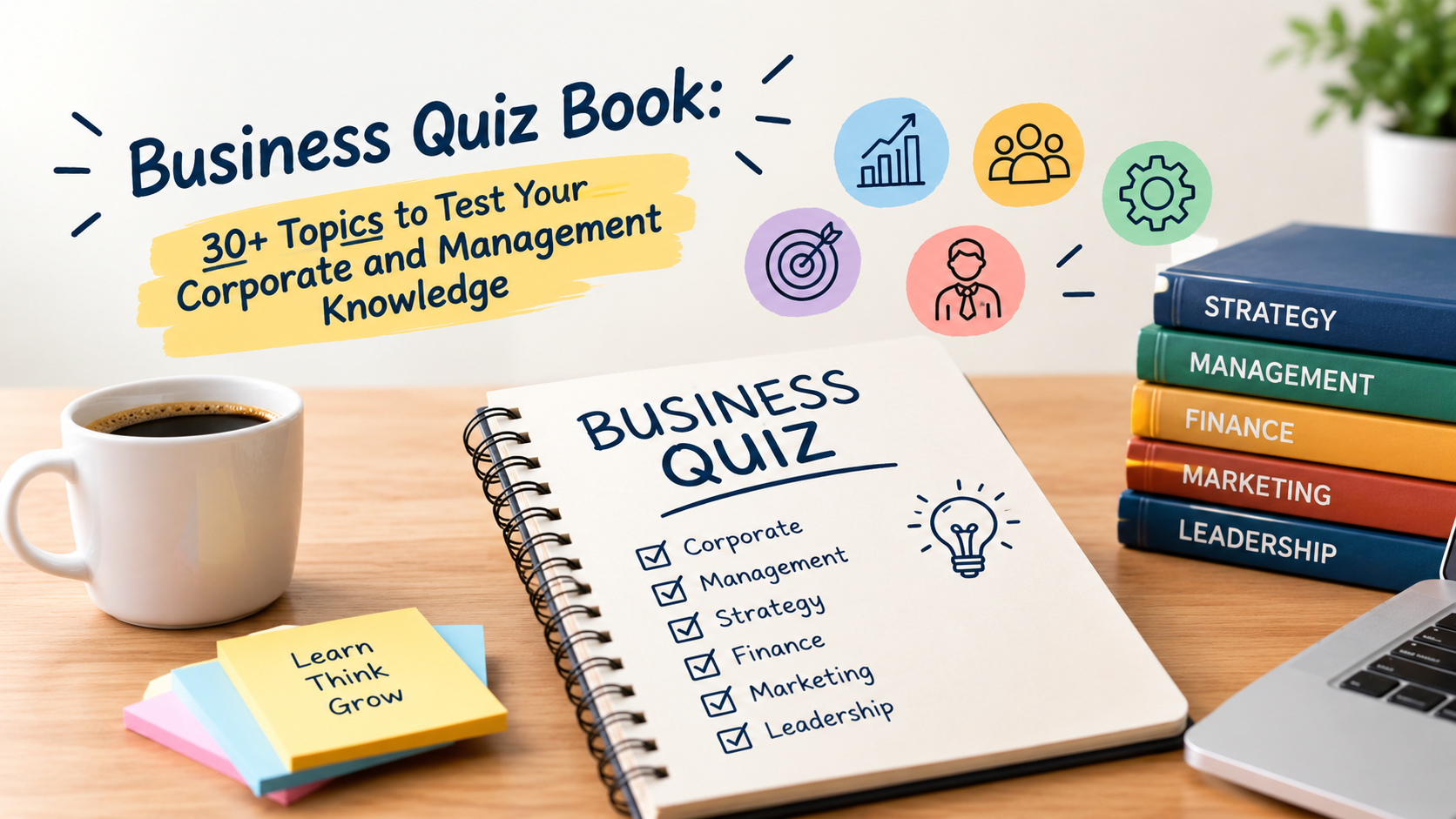
A practical guide to business awareness, quiz-based learning, and the corporate knowledge that supports exams, interviews, and career conversations.
Quick Answer: A business quiz tests general awareness of the corporate world, brands, advertising, management concepts, and current business events, usually through rapid-fire multiple-choice or visual-identification questions. The Business Quiz Book from V&S Publishers organises this knowledge into more than 30 sections, from automobiles and FMCG to management terms and quotes, making it a practice resource for business-quiz enthusiasts, MBA and B-school aspirants, and candidates preparing for banking, insurance, defence, railway, and government service exams that include a general awareness component.
Ask most working professionals to name the founder of a well-known FMCG brand, explain a basic management term, or identify a company from its old logo, and many will hesitate. This isn't a knowledge failure; it's a gap in a specific, learnable category that sits between general knowledge and professional expertise: business awareness. It shows up in campus placement group discussions, MBA entrance general awareness sections, corporate quiz competitions, and increasingly in government exam GK papers that now draw on economic and corporate current affairs.
This guide explains what a business quiz actually tests, why business awareness carries real weight across exams and careers, how the Business Quiz Book organises this material, and how to use quiz-based practice as an actual learning method rather than casual trivia.
What Does a Business Quiz Actually Test?
A business quiz is a structured test of general awareness specific to the corporate and commercial world. Unlike a general-knowledge quiz, which spans history, geography, and science broadly, a business quiz narrows in on categories such as company histories and founders, brand taglines and advertising campaigns, mergers and acquisitions, management theories and terminology, stock markets and financial concepts, and well-known business personalities, often mixed with visual rounds where participants identify a logo, product, or advertisement from an image.
India has a well-established business quizzing culture built around this format. The Tata Crucible Corporate Quiz, run by the Tata Group since 2004, is widely regarded as India's largest and most established business quiz, drawing participation from thousands of professionals across corporates each year and running separate tracks for Tata companies, non-Tata corporates, and campus students. Its long-running popularity is itself a signal of how business awareness functions in Indian corporate culture: not as trivia for its own sake, but as a marker of genuine engagement with how business actually works.
Why Business Awareness Matters Beyond the Quiz Table
It Shows Up in MBA and Management Entrance Exams
Business awareness is not confined to quiz competitions; it is directly tested in several major MBA entrance exams. The Common Management Admission Test (CMAT), accepted by more than 1,300 AICTE-approved B-schools in India, includes a dedicated General Awareness section worth 80 of the exam's 400 total marks, a full 20 percent of the score, alongside quantitative aptitude, logical reasoning, and language comprehension. Coaching resources preparing candidates for CMAT consistently advise staying current with business and economic news specifically, since the section draws heavily on corporate and economic developments rather than purely academic general knowledge.
It Carries Weight in Government, Banking, and Defence Exams Too
The book's own description points to banking, insurance, defence, railway, and state and central government services as target audiences, and the exam patterns for these bear that out. In the UPSC Combined Defence Services (CDS) exam, General Knowledge is one of only two or three papers depending on the academy, worth 100 of 300 total marks for the Indian Military Academy, Naval Academy, and Air Force Academy tracks, and 100 of just 200 marks, fully half the exam, for the Officers' Training Academy track. Banking exams like IBPS Clerk and IBPS PO dedicate a quarter of their objective marks to general and financial awareness, which increasingly includes business and economic current affairs rather than only static facts.
Business Awareness Weightage Across Exam Types
| Exam / Context | Business or General Awareness Component | Share of Marks |
|---|---|---|
| CMAT (MBA entrance) | General Awareness section | 80 of 400 marks (20%) |
| UPSC CDS (IMA/INA/AFA tracks) | General Knowledge paper | 100 of 300 marks (~33%) |
| UPSC CDS (OTA track) | General Knowledge paper | 100 of 200 marks (50%) |
| IBPS Clerk Mains (banking) | General/Financial Awareness | 50 of 200 marks (25%) |
| Campus placements & GD-PI rounds | Business awareness, current affairs discussion | Not marks-based, but frequently decisive |
Figures reflect 2025 exam-pattern notifications and are subject to revision in future cycles; always confirm against the current official notification for your specific exam.
It Signals Genuine Business Curiosity to Employers and Panels
Beyond formal marks, business awareness functions as a proxy for genuine interest in how commerce works, something interview panels and group discussion evaluators notice quickly. A candidate who can discuss a recent merger, explain why a brand repositioned itself, or connect a management concept to a real company example stands out from one reciting textbook definitions, which is precisely the instinct business quizzes are built to train.
The Learning Science Behind Quiz-Based Practice
Business quizzing is not just an entertaining format; it aligns with well-established findings on how people actually retain information. In a landmark study published in Psychological Science, researchers Henry Roediger and Jeffrey Karpicke found that students who tested themselves on material through recall retained significantly more of it after a week than students who simply reread the same material, even though the rereading group felt more confident about what they knew immediately afterward. This phenomenon, known as the testing effect, is precisely what a quiz format exploits: attempting to recall or select the correct answer strengthens memory more than passively reading a list of business facts.
This is a meaningful distinction for anyone using a business quiz book. Flipping through it as reading material builds passing familiarity; treating each section as a self-test, attempting to answer before checking the solution, builds durable, retrievable knowledge, the kind that holds up under exam pressure or a live quiz buzzer.
Inside the Business Quiz Book: What the 30+ Sections Cover
According to its publisher description, the Business Quiz Book organises its content into more than 30 sections spanning a wide range of business-world categories, including:
- Company and industry categories — automobiles, FMCG (fast-moving consumer goods), and other sector-specific rounds.
- Marketing and brand knowledge — advertising campaigns and taglines.
- People — well-known businessmen and business personalities.
- Media and publishing — publications relevant to the business world.
- Management concepts — management terms, quality control, and management quotes.
- A dedicated visual questions section — identifying logos, products, or advertisements from images, a format the book notes is now a near-standard feature of live business quizzes.
This structure mirrors how actual business quizzes are typically run: a mix of category-based rapid-fire rounds and at least one visual identification round, rather than one long undifferentiated list of trivia. Organising practice by section, working through automobiles one sitting, FMCG the next, management terms after that, also supports the kind of spaced, testable practice that retrieval-practice research favours over one long read-through.
Book Snapshot
| Book Detail | Information |
|---|---|
| Book Title | Business Quiz Book |
| Subtitle | Polish Your Business Knowledge Through Quizzes |
| Publisher | V&S Publishers |
| Category | Professional Skills & Career |
| Language | English |
| Age Group | 17 to 35 years |
| Binding | Paperback |
| Colour | Black and White |
| Pages | 256 |
| Price | Rs. 295 (approx. USD 20) |
| Number of Sections | 30+, including a dedicated visual questions section |
| Recommended For | Business quiz enthusiasts, MBA/B-school aspirants, and candidates for banking, insurance, defence, railway, and government service exams |
How to Use a Business Quiz Book Effectively
Cover the answer, attempt the question, then check, rather than reading questions and answers together in sequence.
Automobiles one day, management terms the next, rather than trying to cover all 30-plus sections in a single pass.
Apply the same spaced-review principle that strengthens long-term retention in any subject.
A quiz book builds the foundational layer—brand histories, management terminology, and well-known personalities—but live quizzes and exam general awareness sections also draw on recent developments that a book alone cannot cover.
Logo and advertisement recognition is a distinct skill from factual recall and benefits from its own dedicated practice sessions.
Who Should Use This Book?
Business Quiz Enthusiasts and Campus Quizzing Teams
For anyone participating in or preparing for corporate and campus business quizzes in the style of Tata Crucible, a structured, section-wise reference is more useful than scattered internet trivia, since it mirrors the actual category structure of live quizzes.
MBA and B-School Aspirants
Since CMAT's General Awareness section carries a fifth of the total exam marks, and group discussions and personal interviews during MBA admissions frequently probe business current affairs, this book offers a foundational layer beyond exam-specific test-prep material.
Banking, Insurance, Defence, and Government Exam Candidates
Given that general knowledge papers make up a meaningful share of marks in exams like UPSC CDS and IBPS banking exams, and that these papers increasingly draw on business and economic developments rather than purely academic facts, business-specific general awareness practice complements a broader GK preparation strategy.
Early-Career Professionals Building Business Curiosity
Even outside a formal exam or quiz context, working through a structured business quiz book is a low-pressure way to build the kind of broad commercial awareness that improves performance in meetings, client conversations, and workplace discussions about industry trends.
Frequently Asked Questions
Is this book only useful for people who compete in business quizzes?
No. While it is built around a quiz format, its content—company histories, management terminology, and brand knowledge—is directly relevant to MBA entrance general awareness sections, government and banking exam GK papers, and general professional business literacy.
How is a business quiz different from a general knowledge quiz?
A general knowledge quiz spans broad categories like history, geography, and science. A business quiz narrows specifically to the corporate and commercial world: companies, brands, advertising, management concepts, and business personalities, often including a visual round for logo or product identification.
Does reading the book once make the information stick?
Not as effectively as active recall. Research on the testing effect shows that testing yourself on material produces significantly better long-term retention than simply rereading it, so working through each section as a self-quiz, rather than a straight read-through, is the more effective approach.
How much of an MBA entrance exam is actually general or business awareness?
It varies by exam. CMAT allocates 80 of its 400 total marks, 20 percent, to a dedicated General Awareness section, based on the exam's 2025 pattern, while exams like CAT do not include a separate general awareness section at all, so the relevance depends on which entrance exam a candidate is targeting.
Is a static quiz book enough, or do I also need to follow current affairs?
A quiz book builds the static foundation—brand histories, management terms, and well-known figures—but most exams and live quizzes also test recent developments. Pairing structured quiz practice with regular business news reading covers both the stable and current layers of business awareness.
The Takeaway
Business awareness sits at an underrated intersection of career skill and exam requirement: it shapes performance in corporate quizzes like Tata Crucible, carries direct marks weight in MBA entrance exams like CMAT and defence exams like CDS, and quietly influences how candidates come across in interviews and group discussions. The Business Quiz Book consolidates this knowledge into more than 30 structured sections, including a dedicated visual round, that map closely onto how real business quizzes and general awareness sections are actually organised. Used as active self-testing rather than passive reading, it turns a broad and often scattered subject into a practical, revisitable skill. Readers preparing for exams or interviews can also browse V&S Publishers' self-help and study skills collection or the V&S Publishers blog for more on effective study techniques and career preparation.
This article is for general educational and informational purposes. Exam patterns and marks distribution are set by the respective conducting bodies and are subject to change; candidates should always verify current details against the official notification for their exam.