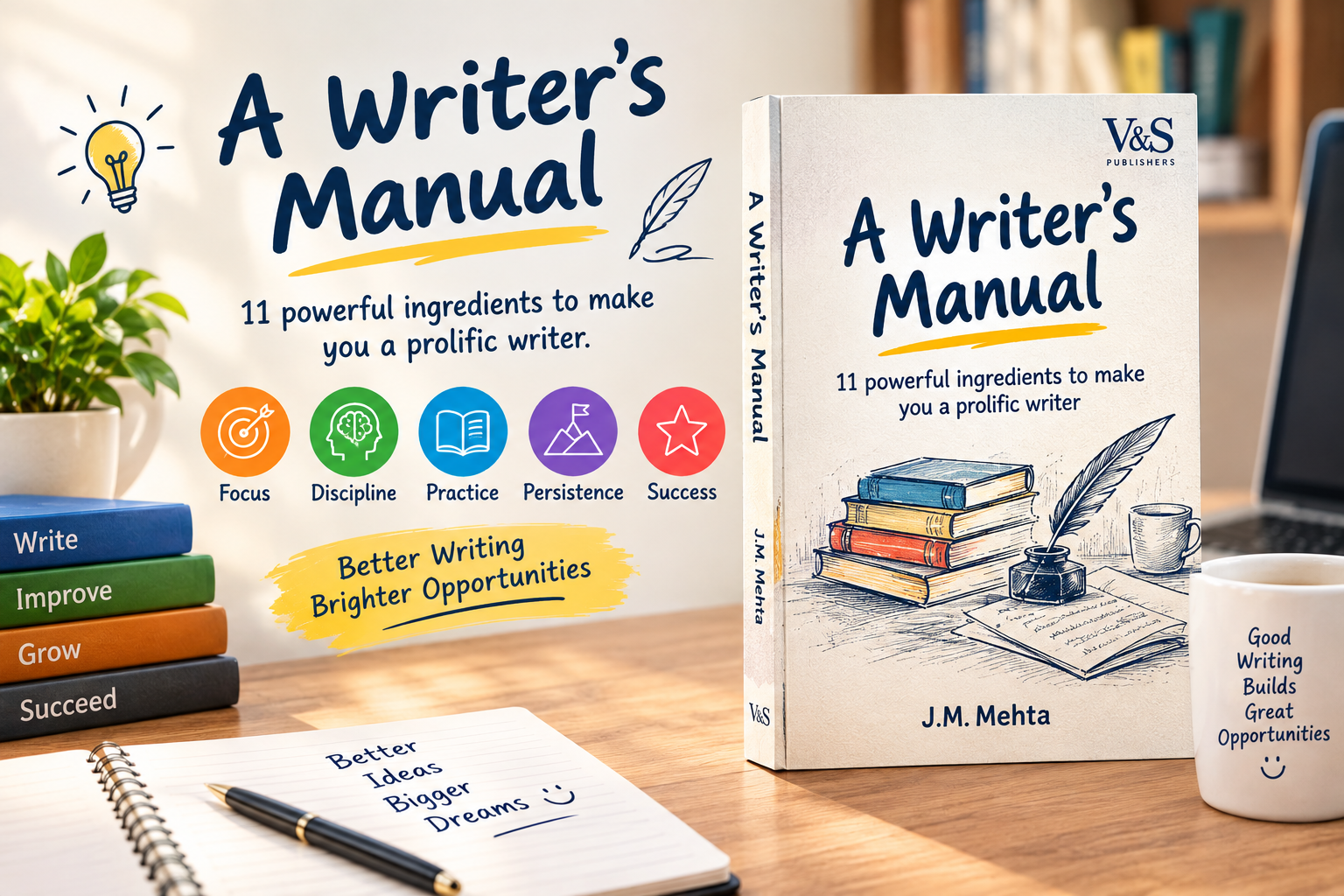
11 powerful ingredients to make you a prolific writer.
Almost every writer who eventually succeeds starts in the same way: with a burning desire to write and very little idea how to begin.
J.K. Rowling's first Harry Potter manuscript was rejected by 12 publishers before Bloomsbury accepted it. Stephen King's novel Carrie faced approximately 30 rejections before it was published.
A Writer's Manual, published by V&S Publishers, is written for that early, uncertain stage and for every stage that follows.
This is not a grammar textbook or vocabulary-drill book. It is a craft and discipline guide structured around 11 powerful ingredients that are presented as essential to becoming a prolific writer.
This guide examines what those ingredients aim to teach, why deliberate practice matters more than raw talent, and how the book fits alongside other English language and self-help titles for readers serious about improving their writing.
Why a Book Like This Matters for Aspiring Writers
The idea that talent alone makes a great writer does not hold up well under research. Psychologist K. Anders Ericsson, whose research on expertise became widely known through Peak: Secrets from the New Science of Expertise, found that strong performance develops through deliberate practice rather than natural ability alone.
Deliberate practice means identifying a specific weakness, working on it intentionally and seeking useful feedback. It is different from repeating the same habits for years and simply hoping for improvement.
Writing workshops and lectures alone rarely produce better writers. Research on skill acquisition shows a gap between knowing something and being able to perform it consistently. Reading about writing is not the same as practising it with a clear structure.
Writing ability also carries growing professional value. India's content-writing industry is projected to exceed USD 1.9 billion by 2030, driven by demand across content marketing, technical writing, digital publishing and business communication.
Quick Data Snapshot
| Statistic | Figure | Source |
|---|---|---|
| Publishers who rejected J.K. Rowling's first Harry Potter manuscript | 12 | Bloomsbury publishing history |
| Approximate rejections Stephen King received for Carrie | About 30 | Widely documented publishing history |
| Projected value of India's content-writing industry by 2030 | Over USD 1.9 billion | Cognitive Market Research |
| Compound annual growth rate of India's content-writing industry | Approximately 8.4% | Cognitive Market Research |
| A Writer's Manual core framework | 11 ingredients | V&S Publishers |
| Recommended age group | 18 to 35 years | V&S Publishers |
| Pages | 168 | V&S Publishers |
Inside A Writer's Manual
The book is written for anyone with a burning desire to write. Rather than presenting a checklist of grammar rules, it explores 11 ingredients that distinguish occasional writing from a consistent, improving writing practice.
Book Snapshot
| Book Title | A Writer's Manual |
| Subtitle | 11 powerful ingredients to make you a prolific writer |
| Category | Self Help and Personal Development |
| Age Group | 18 to 35 years |
| Language | English |
| Binding | Paperback |
| Colour | Black and White |
| Pages | 168 |
| Price | Rs. 195 (approximately USD 12) |
| Publisher | V&S Publishers |
Beyond the 11 ingredients, the book examines how established writers overcame personal drawbacks through hard work, patience, determination and self-belief.
The central message is that writing from the heart, believing in the work and continuing through setbacks are common qualities among successful writers.
Readers can explore related titles through the Self Help and Personal Development category or browse the complete V&S Publishers catalogue .
The Two Halves of the Book
Part One: The 11 Ingredients
The instructional core explains the habits, techniques and mindsets that influence writing quality. It aims to make progress more consistent and less dependent on occasional bursts of motivation.
Part Two: How Great Writers Overcame Their Drawbacks
This section studies the patience, hard work and self-belief behind successful writers, focusing on their difficulties instead of only their finished work.
Why Talent Is the Wrong Place to Start
A recurring theme in writing research and in the book's framing is that natural talent is a poor predictor of who becomes a successful writer.
Ericsson's research suggests that elite performers invest substantially more focused effort than competent amateurs. They improve because they train with intention, not simply because they started with greater natural ability.
Consistency Over Inspiration
Stephen King has spoken about writing approximately 2,000 words daily, treating writing as a discipline rather than waiting for the right mood.
This type of consistency, instead of a rare burst of inspiration, is what the 11-ingredient framework ultimately aims to develop in readers.
Grammar Books vs A Writer's Manual
| Factor | Grammar and Rules-Based Books | A Writer's Manual |
|---|---|---|
| Focus | Correctness, sentence structure and vocabulary | Habits, mindset, discipline and writing craft |
| Format | Exercises, definitions and corrections | 11 core ingredients and writer case studies |
| Motivation | Rarely addressed directly | Central theme built around belief and persistence |
| Best suited for | Readers correcting specific language errors | Readers building a sustainable writing practice |
| Real-world grounding | Mostly abstract rules | Stories of writers who overcame setbacks |
Who Should Read A Writer's Manual?
Aspiring fiction and nonfiction writers: Suitable for people who want to write but need help building a consistent, improving practice.
Content writers and copywriters: Useful for professionals entering India's growing content industry who need craft fundamentals beyond grammar correctness.
Students and young professionals aged 18 to 35: Supports readers exploring blogging, scriptwriting, professional writing or business communication.
Writers facing rejection or self-doubt: Shows how established writers worked through similar setbacks using patience and persistence.
Readers of personal-development books: Applies discipline, belief and consistency principles specifically to writing.
How to Get the Most Out of This Book
- Treat the 11 ingredients as an ongoing framework. Revisit them periodically as your writing practice develops.
- Pair every ingredient with deliberate practice. Apply the lesson immediately to a short piece of writing instead of only absorbing the theory.
- Study the sections about established writers. Notice the specific difficulties they experienced and how persistence helped them move forward.
- Set a small, repeatable writing habit. Even a modest daily word target helps build the consistency associated with prolific writers.
- Track your resistance points. Compare the book's discussion of writers' drawbacks with your own habits, fears and reasons for postponing the work.
About V&S Publishers
A Writer's Manual is published by V&S Publishers , a Delhi-based publishing house active since the 1940s.
Its Self Help and Personal Development collection includes the Rapidex English Speaking Course and forms part of a catalogue containing more than 2,000 titles across over 100 subjects and nine languages.
The publishing house has received recognition at industry events, including a Federation of Indian Publishers award for excellence in book production. It continues to expand its English-language and personal-development catalogue for readers building career and creative skills.
Frequently Asked Questions
Who is A Writer's Manual written for?
It is written for anyone with a genuine desire to write, from beginners to existing writers who want to become more consistent and prolific.
What are the 11 ingredients based on?
They are drawn from the author's study of writing craft and discipline, along with observations of how successful writers built and sustained their practice.
Does this book teach grammar rules?
No. It focuses on the habits, mindset and discipline behind good writing rather than functioning as a grammar or vocabulary reference.
Is this book useful for content writers and copywriters?
Yes. Its focus on consistency and craft is directly relevant to professional writers, including content writers and copywriters.
Does the book only focus on fiction writers?
No. Its principles apply to fiction, nonfiction, professional writing and business communication.
How does the book address writer's self-doubt?
It examines how established writers overcame their drawbacks through hard work, patience, determination and self-belief.
What age group is this book meant for?
It is positioned for readers aged 18 to 35, particularly those making career and creative decisions around writing.
Can beginners with no writing experience use this book?
Yes. It is written for anyone with a strong desire to write, regardless of previous experience.
Final Thoughts
Every writer whose work now appears effortless once faced the same blank page, self-doubt and rejection. The difference was consistent, deliberate effort—the territory A Writer's Manual covers through its 11 ingredients and its examination of successful writers.
For readers looking to improve English writing through discipline and craft rather than grammar drills alone, this book provides a grounded and encouraging place to begin.